Thursday, March 24, 2011

Blind Artists (a brief postscript)

Follow Up to Other Posts

Thank you to those of you who told me about using the video link in class, as the story of the blind photographer and the New Orleans band and all of that is very touching to me.

I am in Chicago, doing work for a journalism lesson, and have been trying to let that sensibility inform my own visual notes. Listening to a mix of rain and snow and hail play against the glass of my hotel window, I tried to capture that dislocated sense of mixed up weather by shooting through the thinnest part of the curtains. It is not great, but I am glad to be trying to listen to the world differently.


And inside the Art Institute of Chicago, they have a gallery for sight impaired visitors, where the "wall text" is in Braille and one can freely touch the art. How wonderful!


Several people may have responses about our notes on Kindle versus books: the iPad side of the block is ready to enlarge the dialogue. Something about that may come shortly. Last, at the same museum, their entrance steps have this text-based artwork installed into them, and I am not sure what it means, but I sure do want one for the stairs inside my house!

Sunday, March 20, 2011

Is Kindle an Agent of the Devil?

Thoughts on e-Readers and the Decline of the Book

Although I own more books than just about anybody I know and although the tactile pleasure of a well-printed, well-designed book still thrills me, I also am an advocate for Kindles and other e-book devices. Is this wrong? Am I agreeing to set fire to very church that I want to worship in?

My reactions are complicated by the fact that textbooks soon will be predominantly online (or will they? see below) and in using a e-book, one gives up a lot, including just the pleasure of the paper pages and the ease of making notes and sharing xeroxes of favorite passages.

Former AVC Writing Tutor Abbey Fitting was considering buying an e-reader as the platform for all of her required textbooks next term at CSU Bakersfield. As a lit major, many of her assigned books are available as e-book downloads. She wondered, should she make the switch? After all, the very prestigious WW Norton company has just released their latest writers’ handbook in a mobile phone edition, and supposedly Kindle versions of books now outsell regular editions.

Did she want to spend the money and switch over? The rest of this blog is guest written by Abbey Fitting, as she shares her reasons for the decision she made.


To Kindle or Not (by Abbey Fitting)


For the book lover there is nothing more pure, more essential to life, than a good book. That arrangement of language, whether in poetry or novel or essay form, moves us to tears and to laughter. At times it can frustrate us with complexity while at other times it soothes our hot and angry souls. For some of us it is an escape into another place; for others an inspiration to be more than we are.

Books are a source both of love and of constant anxiety. I always fear that I will end up somewhere without something to read. I am never far from a book and I have them even in my car (just in case, you know). I pack obscene amounts of them on airplanes for fear I’ll finish one or more before we land.

On a recent cross-country road trip I practically installed an entire bookshelf in the back seat, clearly worried that I’d end up in some mysterious part of the country where they didn’t have books and I would finish mine and be left empty-handed.

If were to say to another book lover, “Here, I’ve found a way that you can take your entire library with you, always and forever, it’ll never be more than a few inches out of your reach,” I might have expected them to hug me and award me the bookish version of the Medal of Honor. Yet if I say the above and then hand them an e-reader (a Kindle or Nook or iPad), they will probably cast it to the ground and shun me from the clan of readers. Heretic, they will say. Apostate. Be gone!

But WHY? I imagine myself shouting to them. It’s all there! After all, for books, it seems that if everything I have listed above still exists if it is translated into a digital format. The power of the story to sweep us away, the joy of an excellently written poem—it’s all STILL THERE. And consider the possibilities! No more traveling with just five or six paperback books, you could instead travel with one slim Kindle and have inside, magically, 10,000 paperback books! And (almost) anywhere in the world you could order a new book in your native language.

Never. Ever. Be without something good to read ever again.

It sounds like a small version of paradise. Why shouldn’t we embrace the digital book as our savior?

The answer, of course, is not simple. But I think I’ve got it figured out.

It is because our books, or I should say, the printed artifact that we call a book, are so much more than the words they contain. If mothers save clippings of their children’s hair at certain ages, and some sailors collect vials of sand from the beaches they’ve visited, then most serious readers collect books. Our books are artifacts of our lives. They are souvenirs of our changing personalities and tastes. From the copy of Harry Potter that you bought hot-off-the-presses in 1997 to your copy of Shakespeare: the Invention of the Human that you bought in 2007 for a class, these books are the history of ourselves. And not just a visible, tangible way to see the person-you-were vs. the-person-you-are, but also of the places—the physical geography—where you experienced those books.

In December of last term I spent a few weeks in Botswana doing the safari thing with my husband and a pair of friends. For that trip I took with me Neil Gaiman’s American Gods. I’d read it before, but since I’m starting a writing project centered at a place featured briefly (though prominently) in the novel, I was re-reading it for the sake of research and, also, because I just liked the story. Into the daypack it went.

What does the book look like now, after that? Between four twelve-hour flights from here to London to South Africa and back, in between six bush plane flights and five field camps, it took on quite the patina. A thick section of pages came loose after a thunderstorm made the air so humid you could have gone swimming in it. The cover has been bent in a number of places, the spine is so broken at this point that it can lay flat (not easy on a paperback this size), there’s a shoe-print on one of the pages, there’s a dead ant embedded in another, and a number of dead are gnats preserved too. It has a faintly mildewy scent about it (though by now, three months back in the arid desert climate, it is definitely dried out, creating that wavy, pleated look).

In some ways this beat-up novel has taken on a different story, one not written by the author but written by me: Abbey’s travels in Africa. I read this book and heard hippos fighting over territories. I read this book waiting for a bush plane to come pick me up. I read this book and looked up to discover a group of giraffes (young included) moving into the camp, browsing the leaves high over my head. I read this book and looked up to discover a group of vervet monkeys were sneaking closer to attempt to steal my snack. It can do this because it is just one book. This is the book that I chose to take with me; this is the book I read while traveling in Africa.

This is what an e-reader will never be to us. This is what we mourn when we give in and buy one; this is what we shun when we hold fast against the pressure to do so. A Kindle holds 10,000 books, it’s true. It could, potentially, hold all the books currently stacked around my office. But because of that, it will never take on the patina of being “The book I read when….”

It will get scratches, it’s true, but you won’t remember the how or why or where, because it will go so many mundane places with you. And when it breaks, you won’t fight with yourself about replacing the way I do when I consider buying a new copy of a book that I’ve just worn the spine out on completely, because it’s like buying a new cell phone or a laptop: You expect to need to replace it. You expect the battery to wear out. You expect technology to leap ahead and leave it behind.

This doesn’t happen with our physical books. We buy new books, sure, but we love them or we pass them on. We don’t consider our books outdated; we don’t need to upgrade them. If anything, we love them more as they get older. We love how the ideas that had been so commonplace suddenly become stranger and stranger. We love that odd smell they take on, or that weird yellow color.

I suppose ultimately what I’m trying to explain is not why you should avoid an e-reader— please, buy one. I wish Amazon no ill will, and I have spent many days at Barnes & Noble, looking at a Nook. But rather, what I am trying to explain is why it is so hard for us to give up our real books. Why we fight so hard to keep them, and why, in our hearts, no matter how good the story is on the e-reader, we will always know that it is not really a book.

The book is dead. Long live the book.


Monday, March 14, 2011

From Littlerock to Paradise in 20 Frames

What Blind Photographers Can Teach All of Us
 
As singer Leonard Cohen says (and poets like to repeat), everything has cracks—that’s what lets the light in.

We think of our world as flooded with light, and, in the Antelope Valley, there’s often so much sunlight that to hide from it we need sunglasses tinted as dark as welding goggles and deeply-canted parking awnings.

If some of us have too much light, what about our friends and neighbors whose eyesight is, in the literal sense, absent or deeply impaired?

I have been thinking about blind photographers lately, and that has made me reassess what it means to be an artist, what kinds of pity I too-quickly put onto people, and what assumptions I have been making about creativity. An passage adapted from the Bible reminds us that there are none so blind as those who will not see, and conversely, the true artist is she or he who sees more deeply, more wisely than any of the rest of us. Great art opens our eyes in many ways.

A video link proves this well, as it introduces us to the world of Peter Eckert, a blind photographer who does amazing work, and reveals the difference between sight and insight, between hope and despair. This blog will not usually embed many video clips or external links, but this is truly something beyond average that I think you will be glad to have seen. This four-minute video should help all of us think about labels, ability, and vision. It really is inspiring.

http://vimeo.com/14179548

I had been aware of his work before, but had not paid attention to it closely enough. This is not to my credit—we should never be so busy or so prejudiced we can’t make a space in our hearts for the best that the world has to offer.

In case the video link didn’t work for you, here is a copy of something of his from a book called Sight Unseen: International Photography by Blind Artists.


This book documents a show that was hosted by UC Riverside’s California Center for Photography.

One of the artists profiled in the show (which is available for review online, as is the exhibit catalogue) uses braille typography to overprint his photographs: completely unsighted visitors may run their hands across the print and read it that way. Here is a photo from the book, of an image by Gerardo Nigenda, an artist from Oaxaca.


(Sorry about the distortion on this one: future blogs will be using a scanner not a camera to make reproductions and will have better quality images!)

The exhibit’s curator suggests that photography by sight-disabled artists often falls into three groupings. One group of these artists "constructs, maintains, and curates private, internal galleries of images. Then they use cameras to bring their inner visions into the world of the sighted. 'I photograph what I imagine,' writes Evgen Bavcar. ‘You could say I'm a bit like Don Quixote. The originals are inside my head.'"

This from an essay titled “Shooting Blind.” Douglas McCulloh goes on to say that a “second group deploys cameras to capture the outside world, but, being blind, operate free of sight-driven selection and self-censorship. Marcel Duchamp wrote of ‘non-retinal art,’ an art of the mind, of concept, of chance. These artists are engaged in non-retinal photography. The results are pure, unfiltered, and inherently conceptual. They operate beyond the logic of composition or the tyranny of the decisive moment.”

Last, McCulloh explains, “The third and smallest group is legally blind, but retain very limited, highly attenuated sight. Most photographers see to photograph. These artists photograph to see.” An example is Bruce Hall, from Irvine, California. Here is a portrait he has made of his autistic son enjoying the tactile pleasures of the bath. I don’t know about you, but I can’t match this with pictures of my own kids. The purity and innocence of the moment are perfectly served by the artistry of the print.


All of this inspired me to go out this morning and tree to see what it is I overlook daily. Yesterday I had come back from a wedding in San Diego in a great hurry, and while I didn’t get a speeding ticket, I blew through the towns along the 138 as if they were impediments or nuisances, not communities where people live, work, pray, or support my wage packet by attending AVC English classes. I went back this morning to see what things I had been missing. Quite a lot, apparently!

Here are a few things from today’s exploration of Littlerock.

Thank you to these other artists for making me confront my own blindnesses.

Son of Blog

Regular Feature Returns

Sorry for the delay: after Antarctica, AVC’s blog options began to divide and braid like glacial streams. Santi Tafarella will be helping with an accreditation blog and a pedagogy blog for the Basic Skills program, both of which will be available only to faculty, and Charles Hood (self portrait below: I am the tall shadow, not the fat dinosaur, though some would argue the reverse) will be doing the community blog, which is the one you are reading now.

Santi’s updates depend on program review schedules and faculty input, but this blog will change about once a week on average. Initial features in the next month will talk about blind photography, the amazing renaissance in children’s picture books, the aesthetics of sports, whether or not Kindle is an agent of the devil, and the relationship between the poet Walt Whitman and the AV Symphony. On average we won’t cover politics, offensive content, or immediate news items; other venues exist for those. We will though have guest bloggers and a variety of opinions. The first of the new, post-Antarctica posts will be up shortly.

Sunday, January 23, 2011

Final Chapter: Boondoggles and Bag Drags

A Visit with Erebus, Odin, and Other Stray Gods

In local slang, “boondoggle” is a good thing, a coveted thing. While in general use it means to scam somebody or put in a bogus government contract, around McMurdo the best employees are rewarded not with a cash bonus (though they get those too), but with boondoggles. There’s a verb, too—“Whatcha doing? Just booning on up to New Harbor Camp for the day.”


There are working boondoggles and just straight fun boondoggles, but the premise is the same: a worker usually stuck at McMurdo for the season is allowed to tag along with a science crew or be assigned to a work party going off base. After months or years of steady drudging labor, at last you get to get the heck out of Dodge.

Of course seen in that way, I think my whole life has been one long boondoggle.

It has been cold in McMurdo lately and factoring windchill, has been getting down to zero even in town. (All blog temps are in Fahrenheit by the way, and shame on me for not being clear sooner. Sorry Dr. Yorke!) When I went to bed, stray confetti bits of snow were kicking around like tiny wads of trash. A change came overnight and the morning was clear, calm, and even nearly almost sort of warm. A perfect day for a helicopter ride.


I had an hour of flying time still allocated to me on my NSF account and a spare back seat going unused, so by prior arrangement, two McMurdo workers got to boondoggle along with me today. Please say hi to Jules and Dean. He’s got an academic’s ponytail and is taller than I am, and she lives in Idaho when she’s not here—many workers here are from Alaska, the Rockies, Idaho, all those cowboy and free spirit kinds of places. Some people just don’t like to be hemmed in. Jules also holds title as the longest continuously working person down here. She really doesn’t want to be hemmed in.


We weighed in and got helmets fitted, and in the waiting room I studied this chart. I realized if it were an emergency, one button would look like the next, so I took a picture. I guess I was thinking that as the ship goes down, I will fish out my reading glasses, squint at the back of my camera, and calmly read out the directions for others to follow.


We had several destinations today, as I continue to put air operations into a coherent perspective. The first was to cross the now-disused sea ice runways close to town that are operational from spring through early summer. As the ice thins, all ops shift out to Pegasus, five feet of tamped snow on top of 150 feet of glacier ice. This is where the opening blog shots came from, as I stepped off the C-17 from Christchurch. Pegasus was our second goal, and as this shot below reveals, finally now I could see the infrastructure and relationships better, as we surveyed the packed-snow runways 700 feet off the deck. It is a bit like a model train set with a whole lot, lot, lot of Styrofoam.


Done with that leg, we began to climb towards Mt. Erebus, an active volcano and unfortunately the site of a number of aviation disasters, including a famous crash of Air New Zealand Flight 901, which in 1979 took the lives of all 257 people on board. Shaped almost like a child’s drawing of a classic sno-cone volcano, this is one big mountain. The summit is 12,448 feet tall; smoke plumes trail from it, and inside the caldera is a pool of molten lava. (I have seen it from a webcam in Crary Lab, but it’s not the kind of thing you fly a helicopter into.)

This shot may look a little psychedelic, since the sun was bending in interesting ways through the front window. Most of the shots in today’s post were taken not through the windscreen but from open air, as I put the camera (and my hands) outside via a small side window. At this elevation, air temp was minus 22 Fahrenheit, plus there’s a pretty substantial windchill due to our airspeed, so nobody can claim I don’t suffer for my art.


These white knobs along the ridge are taller than houses. They are pillars of frozen steam, a kind of ice stalagmite marking vent holes on the side of the volcano. As Susan Lowry would say, Cool Beans!


History, not geology, brought us up this high. In 1971 a Coast Guard helicopter lost power and crashed, though luckily everybody on board survived. (I guess they did not need to take a round robin vote on who remembered the safety poster in the hanger.) I had heard of it and wanted to see the grim yet oddly compelling wreckage. It almost looks like a sculpture of modern art, snowed up after a museum has gone out of business. In mythology, Erebus is the son of Chaos. The wreck certainly is a reminder of the reality of what all of Antarctica is: large, beautiful, and unforgiving.


Those last three words prompt me to include a shot I made just for my own private art collection—maybe to go up on the wall as a large print, maybe not—but these crevasses also are large, beautiful, and unforgiving. As glaciers descend down a mountain’s slopes, the ice bends and cracks, sort of the way wedding cake would look if you zoomed in macro close to the break where the knife pushes through the frosting. These fault lines have an odd beauty, at least to me. And these are immense: the entire AVC library could disappear inside the deepest central crevasse, leaving nothing showing on top. Large, beautiful, and unforgiving indeed.


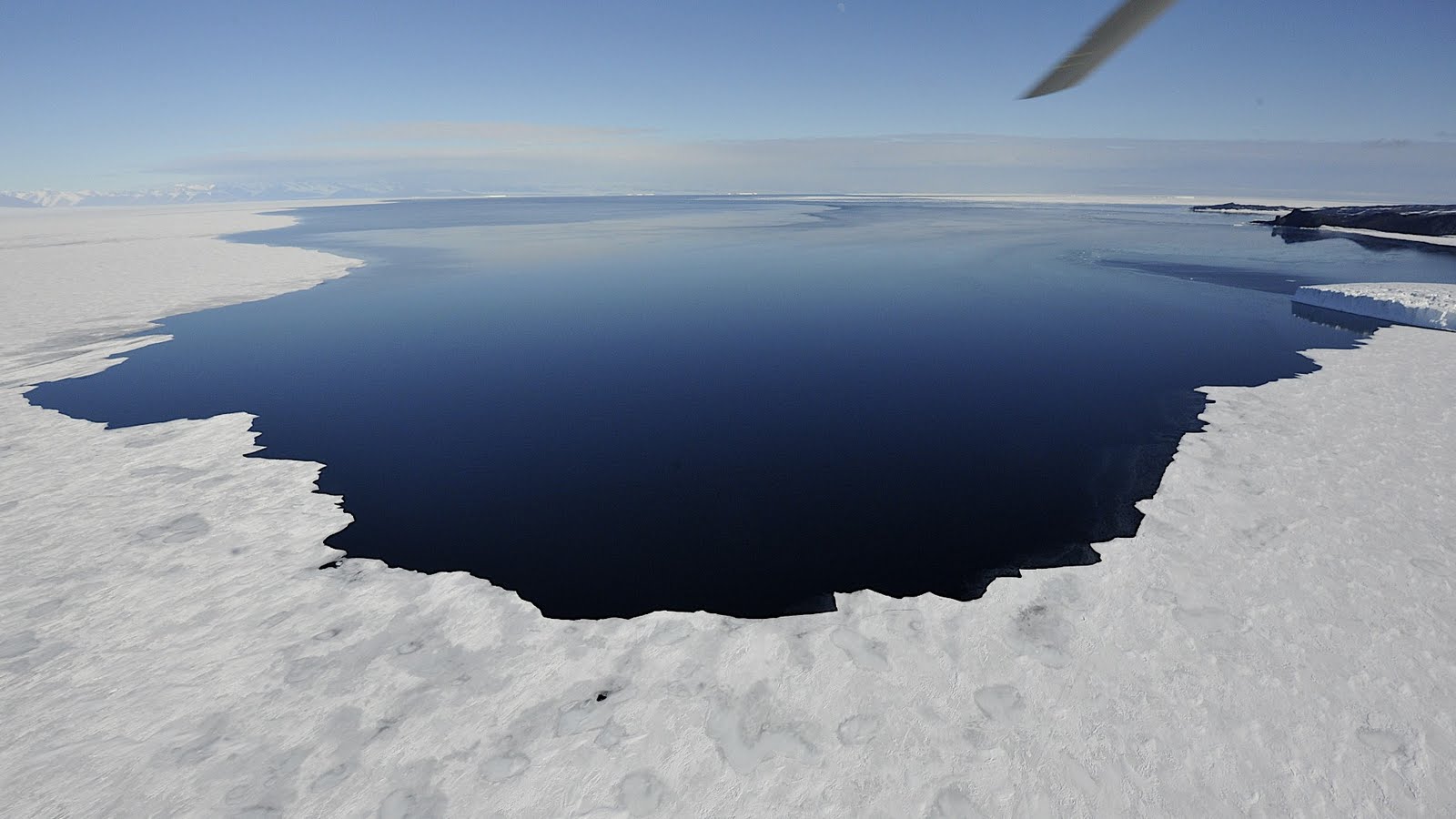
To get back to McMurdo we took a swing out to open water, where last week there had been an active pod of minke whales. They have found better hunting elsewhere, though the scenery was still just as grand. The helicopter rotor blade has dipped into this wide-angle shot.


As if to make up for the missing cetaceans, along the edge of the ice numerous small flocks of Adélie Penguin (Pygoscelis adeliae) waddled, slid, and dove. They are named for an explorer’s wife and the word is pronounced “ah-DELL-ee,” sort of like the city in India. They eat krill, fish, and squid. When the icebreakers clear the shipping lane in to McMurdo, the open water can lure these cute little guys within a half mile of town.


As an earlier blog says, two large ships need to make it into McMurdo this year, a fuel tanker and a regular cargo freighter, the second of which brings in supplies but also takes out things like the refrigerated containers of meteorites. With the U.S. Coast Guard vessels all busy elsewhere this year, a chartered Swedish ship, the Oden, has been working on making a clear path. It’s certainly up to the task, since this same ship on a different mission once pushed through the ice all the way to the North Pole.


In English, we know the name “Oden” as the mythological Norse figure usually spelled “Odin” with an “i,” a god of war, death, wisdom, and poetry. Working its slow way up and down the McMurdo shipping lane it reminded me less a warrior doing battle and more of an ox hauling a plow, a reliable and sturdy beast doing its steady work in the fields, day after day after day. Somehow I feel like I can relate. A newspaper reporter helping ferry loads into his daughter’s college dorm once said, “Dads are the oxen of family life.”

The pilot taped his watch. Cinderella’s coach was going to turn into a pumpkin, so we followed the ship channel back to McMurdo. That is Erebus in the far top left, and in the lower bottom left, a finger of brown land is where Hut Point holds the freeze-dried time capsule of Scott’s 1912 supplies.


It’s an ugly sort of place, yet has begun to feel like home.

Tonight I have bag drag, and tomorrow afternoon, if the C-17 makes it through, I will drone my way back to New Zealand, home of kiwi fruit and backdrops for the Lord of the Rings movies. A mix of feelings rises in me. After Tybalt wounds Mercutio in Romeo and Juliet, the dying Mercutio darkly puns that the hurt will turn him serious (but also dead): “Ask for me tomorrow and you will find me a grave man.” I feel a touch that way too.

Ask for me tomorrow and I may be a bit grave, a bit sad.

For now though I am still high from the glories of the helicopter trip, as this final coda picture shows. The question is, do I look so giddy because I plan to dream of helicopters and frozen geysers all night long, or is it because a rumor has been flaring through camp like an oil well fire—can it be true? Dare I hope? Is it true—is Frosty Boy finally fixed for good?

I will smile all the way to the Galley.

Saturday, January 22, 2011

Frisbee Golf at the End of the World

Life at the South Pole

My McMurdo interviews temporarily caught up, I was manifested for another flight. At long last, a childhood dream was about to be realized. The Pole at last! Once more I would be taking an Air National Guard LC-130 from Pegasus Airfield.


First though, we had our safety briefing. If cabin pressure goes whoosh, the pilot, when he can, will start to drop to a lower altitude. (Given the size of some of the mountains en route, not too low I hope. Some of the Transantarctics are just shy of 15,000 feet.) Until then the plane reached better altitudes, in an emergency we had plastic baggies to stick over our heads, with temporary packets of jiffy-pop oxygen inside. About half probably wouldn’t work so if there were a real emergency, we were encouraged to keep trying—there were plenty of extras on board.


We took off on time and begin the climb towards the Polar Plateau. Some read, some slept, others went back to snatch a lie-down among the cargo pallets.


For me, the magnet was the porthole. Our course to the Pole ran a diagonal transect through the huge, sprawling Transantarctic Mountains, one hundred miles wide and two thousand miles long, and each minute of flight took us past unclimbed cliff faces, over immense ice falls that could swallow a city skyline, and along side glaciers flowing onto other glaciers. Who knows what is buried under all of that ice? A hundred new Yosemites wait to be discovered—and, maybe, diamond mines and oil fields, one reason the various research nations (China, Russia, Chile, Australia, and so on) want to keep a presence “on the ice.” The U.S. base at the South Pole is a premier science lab but it is also a factor in a geo-political chess game. None of that mattered on this flight.


The immensity of it all defies narration. You could set Switzerland down in the middle of this mountain range and it would be as small and lost as a child’s sneaker left behind in the mall parking lot. Antarctica is bigger than the mainland United States.


After three hours, we landed at the South Pole.


As with the WAIS-Divide camp, the plane delivered AN-8 fuel, which had to be pumped off, and as that was being done, ground crews began to reload the plane the outbound cargo, a mix of leftover construction materials from the new base (2008), materials from the previous two bases (going back to the 1950s), and the simple, expected things like trash and science cargo, including more meteorites—and about them we will talk in just a moment.


The main station is on stilts so that it’s not buried by accumulating snow. (The previous shape, a lovely Logan’s Run 1970s dome, had not worked out.) With the right control of air flow (manipulated by sculpted berms up- and down-wind), the wind scours out the snow around the footings. The whole complex rests on hydraulic jacks, so as the inevitable snow does accumulate over the years, the buildings can be raised up another few levels to stay above it.


Just in case anybody might suspect that I am actually in Hawaii, listening to Don Ho on my iPod while I download South Pole images off the internet, here’s the obligatory self-portrait at the geographical Pole proper. This “is” the South Pole. With windchill, air temp is just touching -40 degrees Fahrenheit. I did not leave my face mask down for long.


Adjacent to the geographical Pole, there is a symbolic photo-op South Pole, with flags of polar-associated nations and a chrome-ball topped barber pole. This shot below is sort of a double self-portrait, since you can see the tip of my bunny boot in the bottom foreground. You also can see the flags, just barely, reflected in the edge of the mirror ball.


Inside the U.S. station the floorplan is a modified “W”; here are the dorm pods. Additional summer berths are in huts out of view from this shot. In the main building the rooms are small but Ikea nice, with a bed, closet, nice work table, plenty of electrical outlets, and (best of all), no roommates. South Pole workers (and some visitors) get their own rooms.


During the summer there are 200 on up to 275 people working here, though anything past 250 really begins to feel a bit too crowded I am told—not enough bathrooms, not enough space in the galley to get lunch. The winter-over crew tallies in at 25% of this, fewer and, I would say, braver. They spend a winter in darkness—no sun at all, just the eirie light of the aurora australis turning the sky into curtains of blue and green—and a winter in isolation, since no planes can land, except in the most extreme medical emergencies. All their mail, their groceries, their change of hair-color dye—anything they need has to come in either before the flights close for the season or else wait until next year. One thing they do get to do in the winter is to grow their own fresh food.


Welcome to the greenhouse at the South Pole. No soil is used: plants are rooted in little cubes of sponge and given water and nutrients under growth lamps. Music plays and there is a sofa, so when the endless snow and endless winter get you down, you have a place to come and try to re-center. I think it must be one of the most coveted spots on base, any time of year.

If the green house is in use, still, diversion abounds, all year long. Many of the summer-only employees at the South Pole will go do interesting jobs up north in the off season. They might be rangers in Alaska, deep sea fishermen, scuba instructors, or archaeologists. Crewing yachts is one casual, low-paid, but always interesting way to see the world, and this poster advertises a “how to” information session.


Music is popular (one of the first things I saw when I walked in the front door of the base was a Sousaphone); behind this closed door I could hear the Grateful Dead cover band rehearsing. I am pretty sure that Jerry Garcia is looking down from his rainbow in Heaven, taping his foot in encouragement.


This notice on a lab door caught my eye. It’s hard to read but it’s a subtle spoof on light spectra; note the range set aside for Google secret projects, and also for Death Star lasers. In the galley, a computer monitor scrolls a packet of information, including in-bound flights, timelines of when satellites will be overhead so that Internet access will be available, and today’s weather. On the weather page, for the graphics part, there is a seemingly endless set of adventures with Star Wars storm troopers, who rappel of toilet paper rolls, fight with dinosaurs, and host tv game shows. Gotta love the energy and humor of these people.


Why a bowling ball? Somebody (now redeployed?) used to drink shots out of the finger holes at parties. Why is it still in the dorm hall? No answer. Maybe it’s a legacy thing: perhaps the successor to the bowling-for-shots game is due in soon.


Outside, the arts also flourish. Spoolhenge was very dear to my heart, since some of the AVC faculty have been over to see “Hoodhenge,” an eight-foot tall limestone sculpture in my back yard. Legend has it, it used to be taller. I like it just like this.


Ducts and tubing from previous bases have been made into a kind of open air sculpture: part barn, part sci-fi movie set. This is also part of the best Frisbee Golf route in the world. Just through the end of the tunnel (rather blown out in this exposure) you can see a goal basket.


Here is a better shot of the course.


Not having a Frisbee with me (that so was not on the NSF approved packing list), I had to use snowballs.

Fun is fun and work is work, and sometimes the two mix well. With the arrival of a Twin Otter from a remote field camp, that meant a meteorite crew was back. This was a reconnaissance team out scouting new sites; they still in one austral summer were able to bring back over three hundred meteorites. Main teams, working elsewhere, brought back 900 this field season.


They let me hold one of the large ones, which was unexpectedly heavy. (Well, duh, Hood, you know how dense iron is?) It was probably made of chrondite and was most likely around four and a half billion years old. AVC can get its own meteorite by putting in a request to Johnson Space Center; we maybe have oodles already in the Geology Labs on campus—I must confess my ignorance of what rock samples we archive—but if not, I know now who to contact at the meteorite center to ask for some for us. Once I check with my colleagues over in geology, that’s on my to-do list when I get back.


The woman in this picture has just come back from living on a glacier for five weeks. She is married and has an eight-year-old son. She’s a Ph.D. planetary scientist whose main job is working with missions to Mars. Antarctica always interested her. At a conference, she met some of the meteorite people, and wrote a letter asking to come along as a volunteer. The next year she wrote another one. The year after that, she wrote another one. I want to put something in bold caps here, since this is important: PERISENTENCE pays off. Good things are happening in her life because she went out and made them happen. Nobody is going to hand it to you for free—ask Dr. Fisher, our college president. You need to put up with set-backs and just work through it. In my case, the fellowship I am traveling on I first began working on just under four years ago. I talked to former award winners, I did research on what was being done and had recently been done, I lined up academic sponsors, I got publishers’ endorsements, but most of all, I kept my résumé active: I had a list of projects and artist-in-residencies already completed, to prove that I was worth their time. If you want something, go out and make it happen.


Staying active and being involved may something as simple as helping to offload fuel drums. Just out of view in this shot is one of the most senior meteorite guys of all, somebody who’s been doing this for thirty years. If anybody deserves special treatment, he does. Yet he and I interrupted the interview a number of times just to do something basic like help carry loads. Team work means helping out, no matter what work has to be done.

Back from five weeks the field, the meteorite crew was not done. They had showers, grabbed some dinner, then agreed to meet in the lab. There was a lot of GPS and GIS date to download and transcribe. (We have a certificate program specializing in this, just in case you want to know one way an AVC education ties in to cool future job plans.)


Other kinds of science happen here too, more than I can list. Taken on a less sunny day than the other shots, this facility shown below is the famous IceCube neutrino lab, using sensors buried in ice cores in a one kilometer x one kilometer grid. The sensor strings are a mile long. The IceCube project does cutting edge work in particle physics. There have been tv specials and entire books about it; if you want to find out what a neutrino is and how we see them, there’s a good summary on Wikipedia under “IceCube Neutrino Observatory.” Note the spelling (all one word): get it wrong and you’ll dial up entries on the rapper Ice Cube or the kind you put in your iced tea.


A variety of astronomy projects take place at the Pole. I have a really, really good overview article on it from a technical journal . . . I have it at home, that is. Back in Palmdale, in my home office, my files bulge with articles and the bookshelves bend under the weight of my polar library. Coming here, I just brought down a stripped down sampling of materials with me. This photo is the astronomy building and inside here, um, somebody does something interesting, I just can’t remember what.


Taking pictures at 40 below zero is probably not my favorite thing I have ever done. There are reasons why I took a job in a desert and not, say, Fairbanks. Several people have emailed to ask me what I wear here. When I am suited up, I have about all of the grace and dexterity of an intoxicated astronaut, and so far I have been very glad not to drop a lens cap, since Nikon lens caps cost 27 bucks a go, and I could easily see myself unable to pick it back up.


The white halo around my face in this shot is condensed breath freezing onto my parka ruff. Authentic polar parkas should be trimmed with wolverine fur or wolf fur, since supposedly your breath won’t freeze when it hits those products. The under-fur of the musk ox makes a kind of ultra-soft, hyper-warm wool called qiviut (Scrabble players take note of the spelling), ideal for scarves. NSF is an animal-cruelty-free employer, so no baby seal mittens or musk ox fur face masks for us. We make do with “Government Issue,” starting with the Korean War white bunny boots visible in a lot of these shots. I wear them with three pairs of socks (light, medium, heavy, just in case I have to share with Golidlocks). For the legs, I went out the day of departure to Sport Chalet and upgraded my Patagonia long-john bottoms to a heavier weight of fabric (and am glad I did). Over that layer, at the South Pole I wore a pair of regular fleece pants (on sale at a discount barn in Bishop, years ago), and over that layer, a pair of very thick pile fleece pants that were part of my gear issue in Christchurch. And on top of that goes double-heavy bib overalls, uninsulated but windproof.

Top-side I have two wicking mesh t-shirts, and from a shop in New Zealand, a wicking synthetic fabric field shirt. I bought it because it has large, zippered chest pockets, so I always have a (thawed) pen and sketchpad on one side, and on the other, my reading glasses. Over that goes the heaviest wind-proof pile jacket that Patagonia makes, and over that, “Big Red,” the program-issued down jacket that weighs something like 15 pounds and leans in a corner, standing up, it’s so stiff. Spare camera batteries were kept inside the Patagonia pile coat. Nimble ice climbing gloves by Black Diamond go inside generic Thinsulate mittens. I could photograph in the mittens but not well, and to change settings at all, had to work with just my glove liners on. My hands got cold quickly but so far, so good: look ma, no frostbite.

From the shoulders on up, we top off the outfit with a thick pile neck gaiter, a windproof balaclava (named after a site of the Crimean War, the war that gave us the Tennyson poem “Charge of the Light Brigade), and last, my own private snowboarding goggles, also from Sport Chalet, because they’re polarized and new and hence not scratched up, none of which would have been true about the goggles the program issued me. I am a fiend about top-quality optical glass, and have with me two back-up pairs of very expensive, very top-end glacier glasses. (I also have four back-up pairs of gloves, most with me most of the time, and who knows how many piles of dry socks. My wife was very firm when I left, about the not-coming-back-with-frostbite part of the agreement.)

After two days at the South Pole, I checked in with the comms center to see the status of the inbound LC-130 flight. Despite a grey day and blowing snow, they were en route and on schedule. I had just enough time to grab lunch and pack up.


As the new arrivals were taken in for the briefing, the outbound "pax" (passengers)—myself, a mechanic, and four meteorite researchers—practiced our Spanish at the edge of the fuel dock


And then it was just the long droning propeller flight back to McMurdo. We are given earplugs, and boy, do you need them. At last we landed. Wind was up, temps were down— with windchill, it was a surpising 2 degrees below zero when we set down. Normally that might have felt rather bitter, but compared to the Pole, I hardly bothered to zip up Big Red. Nice day we’re having! Who’s up for beach valleyball?

If this blog has made people want to come down here, McMurdo almost always needs dishwashers for $350 a week, room and board and flights included. When I came into the Galley for dinner after my return Pole flight, I saw these new spa posters put up, advertising for dishwashers. (At least, I think that is what they are advertising for.) Hmm, a long time ago I used to wash dishes up at Sequoia National Park, so perhaps like Kevin Spacey in American Beauty, I maybe ought to think about getting back to my roots and simplifying my life. But do you really think it will make me look younger?