Thursday, October 11, 2012

Everything I Need to Know I Learned from Phantom of the Opera

Life Lessons from Andrew Lloyd Webber

My wife and I have an online Netflix account --- we don't get magic movie gifts in the mail, but occasionally when we boot up the system to download another episode of Dr. Who, the log-in page tells us that something new has been added to the available choices. Last night it said, surprise, you now can see Phantom of the Opera, recorded live at Royal Albert Hall in a special 25 Year Anniversary performance.

Since she and I both have lived in London, various UK venues have a place in our hearts, so as much for the theatre as for the program, we said sure, give it a go.


Now it bears revealing that prior to the Netflix version, I already had seen the play live four times, and I even have endured the movie version too, and in each instance I have come away thinking, "Ummm, so what's the big deal?"

I just don't get the enduring appeal. The problem seems to me that Phantom of the Opera violates the usual laws of story telling.

In a regular hero quest, we have a princess in a tower or enchanted sleep, and to earn her love, the questing knight has to overcome a series of obstacles, usually by combining courage and mental agility with a spiritual purity. He is supposed to be rich and handsome, but that's not why he gets the girl: it's because he tracks down the Holy Grail or locates a Horcrux or blows up a Death Star or two. Society is better off with the hero around: fewer dragons, more talking donkeys.

Phantom violates this. I don't get it. The hero who gets the girl doesn't do much more than stand around and look pretty, and once in a while sing something or other. He is rich, but that's as far as it goes. It's the Phantom himself who solves puzzles, writes operas, overcomes adversity. And apparently he's a hell of a music teacher to boot. He's the force of creative energy, yet in every single production, the creative, ambitious genius is killed (mostly for the crime of being ugly as a baboon's backside) and the standing-around-with-hands-in-his-pockets schmuck wins the princess.

I don't get it.

Of course Andrew Lloyd Webber himself doesn't really need me to get anything. As the man behind Evita, Jesus Christ Superstar, Joseph and the Technicolor Dream Coat, and Cats, he can laugh all the way to the bank. He owns Watership Down (famous for a novel about rabbits) plus has almost as much money as J.K. Rowling --- and a better art collection.

Even in the 25th Anniversary version the audience was weeping with joy when he came out and strutted around the stage. He got more applause than the main actors of that performance.


True, if you Google "I Hate Andrew Lloyd Weber," you will get a long list of hits. That does not negate the enduring appeal of this particular musical.

If you can't beat em, join 'em. So I have decided to embrace my inner Carlotta and live life according to the morals modeled in Phantom of the Opera.

Lesson 1
Never Take Off Your Mask

Phantom's downfall begins when he takes Christine to his secret lair the first time and, ungrateful wench that she is, she rips off his mask. At the end, a second mask removal brings down an angry mob and the end of the Phantom empire, if not his life. (Phantom's final fate remains ambiguous. Perhaps he escapes to Argentina with Evita.)

Moral of the story? Never let anybody see inside your mask.


Even the lead stars know this, during the curtain call. KEEP THE MASK ON.

Do not let people know who you are: always hide your true motives, your real self, the inner you. This is true even while rock climbing, as this shot of a mystery guest below reveals. This is one of the star teachers of the AVC Language Arts team --- but who, who, who is it? Wisely, he does not take off his mask, and all we can do is admire his masculine hands in their athletic tape, and the colorful patterns of his mask. Never let anybody ever see the real you, or they will reject you, marry a dork, and call down an angry mob to defile your secret lair.

Lesson 2
Like Toddlers, Women Need to be Watched Closely

Phantom reminds us that women need to be protected, even duped if necessary. Men need to watch over women, control them, plan their lives for them. Women can be laughed at if necessary and made to croak like frogs but always have to be managed or manipulated. A woman is never intact on her own or allowed to be an autonomous free agent. A woman is never to be trusted.

The Phantom trusted the stern ballet teacher, who initially (since she wears black), seems to be on his side. Nope, in the end, for no particular reason, she betrays him. Typical woman!

Christine Daae (please insert an imaginary accent mark over the final "e" of her name since Blog Spot won't do it for me) has her life managed by a series of men, each in turn. Her dead father has told her she needs an angel of music (presumably, a MALE angel of music), which, luckily for her, the Phantom himself agrees to be. He in some slightly devious, unexplained way can appear to her in her mirror, and without any sexual hanky panky (we assume he is a gentleman and averts his eyes when she's adjusting her nether garments in that same mirror), is able to give her voice lessons. And boy, they really have worked --- Christine can just about sing the chandelier off the ceiling.


Is she now set up, ready to become the next Sarah Brightman and maybe even marry Andrew Lloyd Webber himself? Or maybe she likes girls, plans to run off with the ballet-meister, Miss Giry. Alas no, since the play insists she can't have the world-class performing career the Phantom has prepared her for. Why not? I guess he won't be able to manage her affairs well enough, since he can't go to Wal-Mart in the daylight. (He has to wait until after dark, like the other zombies.)

So instead of a partnership with the angel of music, and instead of, say, a solo career, the plot wants us to think that Christine needs a husband, and so it's implied, once Raoul marries her, she will disappear into the vast kitchens of his presumed estate and then spend the rest of her life in pearls and heels, perfecting her meatloaf recipe. (Rocky Horror Picture Show fans can insert her the famous audience tagline, "What, Meatloaf again?")

The death of the Phantom and the utter ruin of the opera house is somehow the desired goal of the production, the thing we all applaud. That it will put all the ballerina girls out on the streets and deprive the Parisian audiences of a venue for public entertainment is no matter. So long as we get Christine safely busied with Tuperware and tykes, that's all that counts.

Gentlemen of AVC, take note. Andrew Lloyd Webber has sanctified it: the 1950s were right, and whatever happens, keep your wife off the stage, don't let her hang out with creepy older men, and if you meet overweight divas with foreign accents, it's okay to mock the pants of of them.

Lesson 3
It's Not Okay to Kill People, But if You Do Kill People, Kill Fat People

Excluding the Phantom himself, whose fate we are not sure about, in this musical two people die. In the old World War II movies, if there was a squad of soldiers, usually it was the African American soldier who would die first. If that racial profiling is not followed (since this is play without people of color), next on the usual list are social deviants --- foreigners, people of more than acceptable weight, loners. The first death in the play combines a figure who embodies all three deviations from the norm. Alone in the flies, the overweight props guy has been dismissing the possibility of the Phantom being real plus annoying the ballet girls with his hangman's noose antics. He is alone, probably unshaven, and in the productions I have seen, not slim and young but pot-bellied and older.

That's it. He's doomed. If you're not going to be one of the beautiful people, singing on the stairway in a glittery costume in the "Masquerade" sequence, at least try to be FRIENDS with beautiful people. Otherwise, it's a pauper's grave for you.


The other murder victim is Carlotta's partner, the fat and foreign Ubaldo Piangi. His first name even sounds like Pig Latin for somebody who's bald --- another social crime.

So that's it, ladies and gents, that is the moral universe of Phantom of the Opera: keep your mask on, control your women folk, and drink your Slim Fast.

For this we each dressed up fancy and paid a hundred bucks a seat?

Call me Old School, but I am going to stick to the true heroes in this world... people who know their left hands from their right, who live by a cuticle code of honor, and whose light sabers are always ready and bright. Yes, I am talking that most significant of cultural icons, Thumb Wars.


Friday, October 5, 2012

Picasso, Shark Week, Hot Wax, and Laundry

What the AVC Art Gallery Shares in Common with the Norton Simon Museum of Art

On the very comprehensive website run by the Academy of American Poets, there's a side feature that organizes poems by category. Heartbreak of course is near the top, as is whatever holiday will approach soon --- yes, there's an icon to click for a list of poems about Halloween --- and this master list of options (one assumes) caters to what the Academy thinks the average person might need, poetry-wise. These pre-sorted lists reflect social expectations, not an actual survey of what poets these days most often do (there is no link for poems about semiotics or roadkill or even the painter Cezanne, even though all of those subjects are ever-present in English-language poetry), and so, because of that expectation, it's not surprising that there is even a link for poems about sharks.

And it turns out, this has indeed been a fruitful area of inquiry for modern writers, and the website editors are able to present to the Internet public not just an essay about sharks in poetry, but clickable links to about 35 examples of shark poetry.

Alligators and tigers, one hopes, will soon be added next.


What there is not up yet is a category or link for laundry poems. This seems entirely unfair. First, of course, it's something we all do --- except I suppose the very rich. On the opposite end, the poorest side of society may do more than their fair share of laundry, since in American history, it was something we farmed out to the marginalized and the disenfranchised, including African-Americans, widows, and recent Chinese immigrants. I once read in a history of the U.S. cavalry about a fort whose laundry was all done by a local woman, assisted by her loyal husband. It all came to a furious stop when it turned out the laundress was a man as well, in drag, living in happy harmony with another man. They moved away and set up shop elsewhere.


In London two hundred years ago the wealthiest of the central Londoners shipped their laundry out to the then-rural woodlands of Hampstead Heath, where a soot-free breeze could air-dry laundry washed in artesian springs. While it solved a necessary problem, the rich though were a bit uncomfortable about this, being upset by the idea of their intimate sheets and fine undergarments laid out to dry on bushes for all to see. There might have been a good market for some kind of service that would have guaranteed confidentiality, a service advertising, let us imagine, that the work would only be done in an enclosed courtyard, with the linens being only handled by disgraced aristocrats who had fallen on hard times. If you have a time machine, feel free to go back to those days and make your fortune. Please bring back an original Turner or two for me, as finder's fee.

The second reason the poetry site's exclusion is unfair is that it turns out laundry remains a very productive subject for art to explore. Luckily, the AVC art gallery is helping us to appreciate this fact.

The current show features work done in encaustic, a two-thousand-year-old method that uses heated wax to blend and bind color and, sometimes, collage or fabric. It's a two-person show, quite nicely framed and hung. Here is the announcement card.


Both artists work with interior spaces, but Erin has an especially poetic subject: piles of dirty laundry. Why laundry? You can read her Artist's Statement (on display in the Gallery on an east wall) to find out. Meanwhile, here are some shots from the show up now.


Colors may be muted a bit here, as I did not want to use flash inside the Gallery. In the actual show things are more vivid, more present. Laundry never looked so interesting or so good.


This is a show that bridges several traditions. Encaustic, of course, has its own history, one that the show encourages students and visitors to investigate. (I hate to say it, but Wikipedia is not a bad place to start on this topic. There is also a narrative panel inside the Campus Art Gallery itself.)

Meanwhile, laundry itself is a noble and worthy subject for art. Picasso painted laundry workers in his blue period, and an images search for the subject of women and laundry or women and ironing shows his painting, along with work by Degas. Here's a typical search hit.


If one had a magic museum that could assemble work from major lenders world-wide, this could be a very interesting show to curate. I am not an expert, but I have picked up a few reproductions myself, including from a museum in Madrid. Here's a shot from the laundry room at my house:


 We have very good laundry art locally, the most famous of which is The Ironers, 1884, by Degas, usually on display at the Norton Simon in Pasadena. Here is a scan of that painting, taken from one of their "masterpieces" books.


The Shakers, in their purity and industry, never saw a household task they couldn't make more efficient or more elegant. Back when irons had to be heated on the stove, one at a time, they figured out a way to heat the laundry room and keep multiple irons ready at once: a large, central, furnace.


This image comes from a lovely 1987 book titled Shaker: Life, Work, and Art, by Sprigg, Larkin, and Freeman (whose names sound like a law firm out of Melville). It was borrowed from the book donation cart by Santi Tafarella, and then borrowed from him by me --- yes, it is on its way back to the donation cart very soon! Until then I have to face a terrible choice: of my "to do" chores today, which comes first . . . grading papers, or doing my laundry. Uncertain how to prioritize, I sent an email to ace English teacher Scott Covell. "Oh, that's an easy one," he answered back. "Don't do either. It's nice out today. Just go ride your bike!"

Never one to ignore input from my esteemed colleagues, off I go.


Saturday, September 22, 2012

The Last Coal Train out of Clarksville

Dennis Anderson, Bruce Willis, and the End of the Space Shuttle

Like so many other thousands of people around town on Friday morning, including the SOAR high school students on campus at AVC and most of the other schools around the AV, I went out to see the last circuit of the Space Shuttle Endevour.

My wife had to go to work, so she planned one route, and I another, both of us lingering at home until NASA-on-the-internet told us that the take-off was near.


My wife went to 50th E and L, behind the Skunk Work complex, while I went to the AVC land that some day supposedly will be the Palmdale Campus, where Barrel Springs Road turns into 25th East.


From some high ground, using my oh-so-expensive German birdwatching binoculars, I could see the 747 and shuttle combo take off from Edwards, do their Mojave run, and came back down the center of the Antelope Valley. At point I could have taken a picture of the F-18 chase plane, the shuttle combo, and a hot air balloon all in the same frame --- that is, had I not been a dolt and left my camera at home.

But dolt I was, and so I now rely on the leaky sieve called a memory and the hard copy evidence of the local papers. The Antelope Valley Press was loud and proud, as well it should be. Here is their front page from Saturday.


I love the main headline, and think the invisible subtitle must be "We Built this Spaceship (On Rock and Roll)." The Saturday Los Angeles Times went for a two-fer approach, capturing the combo plane and also the crowd beneath. Give this fellow a Christmas bonus for this shot.


This is an event that has captured our imaginations. My brother in Tucson stepped out from work to photograph the shuttle passing overhead, and my cousin took the day off of work to go to LAX. In my wife's office, everybody came in late so they could see it. Dennis Anderson, in his editorial on Saturday for the AV Press, said several astute things. Besides our being able to say locally "We built that," as it passed overhead, Anderson notes that we "need to remember the massive infusions of national capital in intellect, energy and taxes [ for ] the NASA budget that we all contributed." This event brought out people all over California to witness it, and this was entirely a correct response: as a state, as a nation, this is our spaceship, collectively.

The LA Times probably sensed that, and their interior coverage was so large it wouldn't fit on my $3000 flatbed scanner. Here's a portion of their layout.


Gloomy Gus that I am, as I was watching the shuttle do its victory laps over the Skunk Works and other AV sites, part of me felt as if I were watching the last load of coal be hauled away by the last train from a now-defunct mine.

Will our housing prices ever come back? Will we ever see planes like the B2 or the SR-71 filling up the sky? It seems the end of an era. I am one of those left-right-middle independents who feels that the otherwise liberal NEA (National Endowment of the Arts) should have funded overflights of the Stealth Fighter and the Stealth Bomber, not as examples of military technology, but as art performances in their own right. Say what you want about the evil of warfare (and I would have a LOT to say), in flight, those were some very cool objects.

Of course the shuttle will live on. There's the exhibition itself in Los Angeles, there are the thousands of iPhone pictures taken yesterday along Sierra Highway, and there are the movies. Oh yes, God bless cinema, so that we can still relive biplanes fighting King Kong on the Empire State Building or the shot-full-of-holes B17s of the 1990s remake of Memphis Belle coming back again from their raids on Germany. Even to this day that movie gets my students worrying, "Will they make it?"

So we will have the shuttle in front of us, any time we want to click on the DVD player. According to the LA Times blog site "Movies Now," here are a list of films that use the space shuttle in a small or large way:

1979, James Bond in Moonraker
1986, Space Camp
1998, Bruce Willis and company in Armageddon
2000 (and my favorite), Space Cowboys
2003, The Core
and last, a Bollywood film, 2004, Swades.

In Armageddon, Bruce Willis and Billy Bob Thorton and Ben Afleck and all sorts of oddballs and roughnecks have to save the world from an asteroid. According to IMDb, there is a lot of delicious trivia about this movie. Rockhound's line about sitting on a million pounds of fuel in a rocket built by the lowest bidder is a variation of an actual radio transmission by Mercury astronaut Alan Shepard, just prior to liftoff. In the mission itself, after Rockhound gets space dementia, the shuttle crew wraps him in duct tape, which is (IMDb says), NASA protocol for immobilizing a crazed crew member. Last item --- and in the website, there are many more --- but apparently NASA has shown this film during management training. New managers are given the task of trying to spot as many errors as possible. Supposedly there are more than 168. Well, what can we say? It's a Disney movie, not an actual space launch.

In its fun list, the LA Times blog leaves out the heroic role that a shuttle played in the IMAX movie about the Hubble Space Telescope. And so maybe I am wrong to feel pessimistic. The shuttle on Friday was named after Captain Cook's ship (thank you, Dennis Anderson, for clearing that up for me!), and so that reminds us how universal the urge to explore must truly be.

It may be built in Mojave or even India, but some day the next generation of space shuttle will be in service, and after that, another generation yet.

In the end, here is the view some pilot will have. It may not be in my lifetime, but it is coming.


Saturday, September 15, 2012

The World is Too Beautiful for Me to Live In

Ed "Rat Fink" Roth Fights to the Death with Elle Decor (and loses)

Being average is of course a bad thing in American culture, even though by definition, most of us live there most of the time --- most of us have (statistics would remind us) average intelligence, and then with that, an average sex life, and (more or less) average grades in school and average car payments on cars that, give or take, are average. Few of us drive a Maserati, yet by definition, all of us drive cars that run, so we don't inhabit the bottom tier either. Just normal, just routine, just average: that's us. We're not supposed to say so: no presidential candidate would have a slogan that would say, "vote for me, I'm average."

We can't be average and we can't even be a bit more than average. The standard is much higher than that: as the bumper stickers used to say, you can never be too rich or too thin. The gap between the ideal and the real has become so large that it really is beginning to make me feel like I am so far below the desired goal that I may as well give up now. Time to go live in a cave, or maybe join a vegan commune in Oregon. Dreadlocks and soy milkshakes, here I come.

As a writer, I thought I could be okay. Sure, we expect movie stars to look nice: they're fifteen feet tall on screens for an hour or more straight. I can promise you, nobody wants to look at me that big ever, and certainly not for that long. Other occupations too, we expect looks to matter. Rock stars have to look sexy on the cover of Rolling Stone as well as on the Jumbotron screens at concerts. I get that. But shouldn't writing be a place were us average folks might be okay? Who cares if Emily Dickinson had great hair or not, or what basketball shoes Walt Whitman would have worn? We write in the dark, some of us not even wearing clothes as we do so, struggling daily to produce clean and pure language that should (we assume) float free of the burden of good looks and bright teeth.

It also follows that writing doesn't need to be linked to gender: either one writes well or one doesn't, and being man or woman shouldn't enter into it.

Alas, not so, not so. Times have changed. Consider a recent book of poetry, out now for about two weeks --- Thrall, by Natasha Trethewey. Just look at her author photo, taken here from the dust jacket.


I've heard her read at a number of events, and in person she is smart, gracious, human. But because she is a woman, she is expected to be "pretty" as well (and not just pretty, but darn near gorgeous.) Let's compare what her publisher expected of her to what men have to do.

Here are three things from the top of the pile next to my desk. Simon Montefiore just published a book titled Jerusalem: The Biography. It pushes well past 600 pages and is amazing scholarship. He's well-known, as much so as Ms. Trethewey, but oh how their photos differ.

He didn't even have to put on a tie. (As a side note, both AVC's Matthe Jaffe and I both recommend his book very highly.) Next on my stack was a book about World War II, Inferno by Max Hastings. He has a tie and probably combed his hair first, but he gets away with the more tasteful (and forgiving) black and white option.


Last, somebody whose fame now is so well-established he can be black and white AND hiding in the corner of his author shot, Cormac McCarthy, from a too-little known novel, The Orchard Keeper.


Let's go back now to Natasha Trethewey: not only must she be something that is "normal plus x" (something far beyond average), but as a woman, she's expected to out-glam the men, too. The hair, the lighting, the pose: we're in a top-end studio, paid for I assume by her publisher. As AVC English teacher Nicelle Davis said, "This wasn't shot at Sears in the Mall."

One can't even be a poet these days without having to be so beautiful one might qualify for a cover shoot for a fashion magazine. It's really unfortunate, since in her case in particular, her language is so deeply felt and so exquisitely rendered, we do not want any distractions. The marketing department no doubt wanted this particular pose, but I wonder if there was any discussion about what a difficult standard this now poses for the rest of us. How can one top this?

But this escalation of the standard of beauty (not an arms race, but a Makeup-and-Botox Race) spans many facets of our culture. Take this ad for skylights.

Once in a while I stay in converted attic rooms, either in hotels in Europe or else if visiting friends in Maine or other places with hundred-year-old houses. None of them have the cathedral vault space that this room implies, where there seems to be twenty feet of space above the bed. You would have to take out the top two floors of the house to have this much vertical headroom. This is what I should feel guilty for not having? To have a nice bedroom (this ad implies), I need to be a Chinese acrobat in a room painted green with cherry trees on the walls, bathed in enough sunlight to power a small city, while white doves of peace flutter and coo. Hell, I am lucky if my wife and I can half-heartedly drag the quilt over our bed to "make" it, and instead of doves and cherry blossoms, we have allergy pill bottles, yesterday's socks, and about 800 unread books.

I am not saying I don't like the lime green paint: it just seems like it represents a few hundred dollars in primer and finish (and about five weekends' of labor) that I just am not likely to spare, separate from how many cups of coffee I would need to drink before being able to jump in the air even four feet. (And looking at the ad, she's not so much jumping as flying, since the bed itself is not rumpled in the least.)

This is not all that atypical though. Consider this paint ad, from the October 2012 issue of Elle Decor.


Okay, so this says that an ideal couple is (a) just that, a heterosexual (if ever so slightly ethnic) couple, a couple that (b) paints rooms while wearing designer clothes which (c) match, while (d) having the time of their lives with slightly sexual hi-jinks. I should be in my twenties and fit, and, if a woman, I should apply full makeup before starting to do household maintenance, or, if a man, I should go for the metrosexual, Queer Eye for the Straight Guy vibe.

Heck, I am so far from this ideal, I don't even own a smart phone that can scan the QR code at the bottom of the ad.

By contrast, whatever happened to reality just being okay with being reality? I was looking at cars designed by the Rat Fink himself, Ed "Big Daddy" Roth. An icon of the 1960s, his hot rods and dream cars remain legendary. They had a local origin: though he worked in Los Angeles, he comes out of a dirt racing tradition that used to take place on the roads of Palmdale.

In looking at a book about his work, several things struck me.


The first of course was that there were no production codes he worried about. Seat belts, impact ratios, license plates, disability access: none of that mattered. What mattered was getting a big engine in a light body that when they were done, looked cool as all get out.

Some of these cars I saw in person at Auto Shows with my dad; some, like this one, I knew from model kits. (This is the real one, not the scale model.)


This is sort of James Bond meets the Jetsons, and I love it. But in reading about the designer, "Big Daddy" Roth, I was struck by how normal we all used to look, back in the day. Here he is in black and white, running an auto paint business with his then-partner.

This photo and the one above come from the book shown first; out of print, you can find this book used via Amazon. There's also a great 2006 movie about this social movement called Tales of the Rat Fink, which has brief clips of Palmdale racing.

Compare these putzy guys to a two-pager from the August issue of Architectural Digest. Pages 48 and 49 open onto a centerfold spread more lusciously false than any airbrushed Playboy fantasy.


Copy on the left reads, "Kelly Klein and her son, Lukas, in the living room of their Palm Beach, Florida, home." The lad in question, wearing what looks like a jammies top, holds a Lego car or some similar toy, while mom relaxes in cut-offs and an over-sized Oxford shirt. That white sofa? Uh-uh. Not in my house, not with my family. I am not talking even about my cat or my kids. Heck, I couldn't keep a house like that as clean as it appears here --- I would spill my cranberry-and-vodka in about two minutes, not to mention the mud I would have tracked in from my last day hike with Lucy the Dog. And raising kids in a room like this? I don't know who Kelly Klein is, or rather, didn't until I googled her (she shoots covers for Vogue and is ex-wife to Calvin Klein, and is, apparently, celeb enough to make the NY gossip pages for which parties she does or does not attend), but all I can say is that she has one heck of a good housekeeping staff if she can keep her rooms looking like this while raising kids.

Of course she's under pressure to give us this image: after all, don't we expect that the women today be all of this --- perfect careers, perfect bodies, perfect moms, perfect taste in interior design. Everybody needs to amp it up, but women most of all. "Her house is the house we all should want" is the implied message, and with that a second message, "Her body, her blonde hair: she's what you should be, or at least, what you should try to marry."

I think I miss the bad old days, when writers drank too much and we all were sort of ugly. For me, with one book due out in spring and a few more simmering on the back of the stove, it makes me wonder "what's next" in this trend. Should I think about plastic surgery before submitting my next manuscript? Join Jenny Craig? Here's one possible solution for my own author photo for the back of whatever book of mine next blunders into existence. I will take the head shot in my own garage, using that most effect of beauty treatment of all: my own hands.


Monday, September 3, 2012

CSI Palmdale

Learning How to Read All Over Again

In writing an email to UC Berkeley's Robert Hass, a MacArthur "genius" grant winner who also has been U.S. Poet Laureate, I thought that before I chastised him too much for getting his palm tree facts confabulated in an essay on art, I should first make sure my own biological literacy was up to speed. So with my dog Lucy showing me where to go, I decided to take a Labor Day morning walk and see what a piece of Palmdale scrubland could tell me about my own neighborhood.

More than I expected, as it turns out.

I've been here before --- some land south of the aqueduct off of Barrel Springs Road --- but noticed more this time now that I had a camera than I normally do, when usually I am just stumbling along and muttering to myself, "Where has that darn dog gotten to?"

Humans leave a lot of evidence, as archaeologists have shown us many times before. What will some future generation make of this?


Construction waste obviously, and some of the green panels turned up elsewhere in the area, apparently having been used as planking in a rut when somebody's truck had gotten struck.

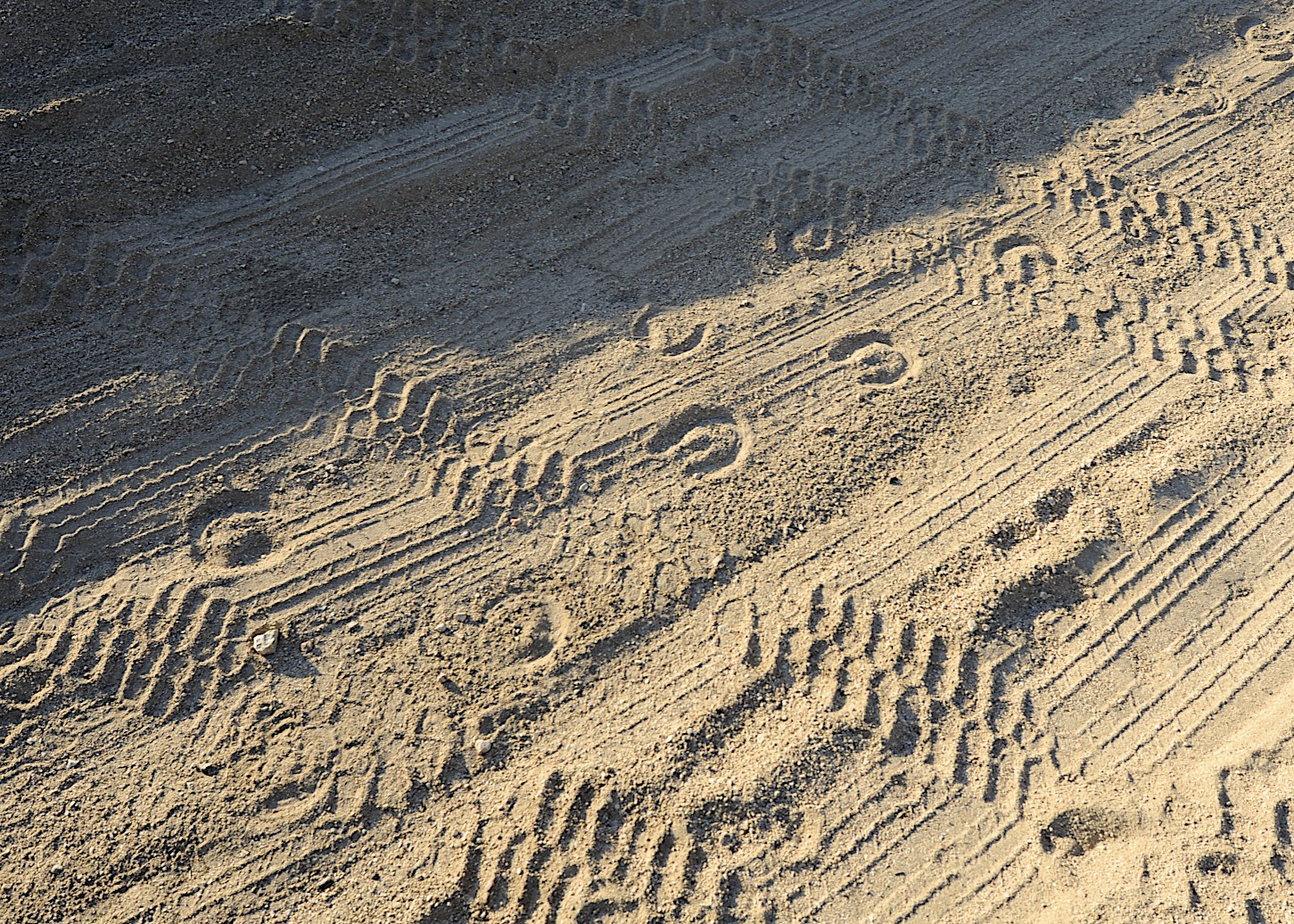
The most obvious place to start is with footprints on the ground. Usually most of us can do basic tracking. Since it has rained in the last week, it was easy to see that there has been a mountain biker passing through recently --- and I would guess a good one by the implied speed that his very direct tracks revealed. Slower you huff and puff, the wobblier it all gets. And he (she?) was able to hold a very lean, efficient course, since the outbound tracks neatly overlaid the inbound ones.

And there were recent motorcycle tracks, a quad, and a light truck. Look at this: horses, too.


Not many coyotes today, though more about them later.

One thing to remember about that attitude of "it's just desert, who cares if somebody dumps trash" (or releases unwanted dogs, or shoots inside city limits) is that if God loves us all equally, so too is all of this land His --- or if not the god of Christianity, then it belongs some Great Spirit or another. We are just his or their stewards. Another thing that ties in with this problem is how degraded this desert has become. This scene would have looked odd to the original Native Americans.


Cheat grass is now the common "yellow" grass of the Antelope Valley, and indeed, most of the American West. Native to Europe and North Africa (same home as the basic city pigeon, by the way), it has displaced the native bunch grasses. A Native American would look out and see Joshua trees and junipers, but the lesser understory, including the kinds of forage that sustained the antelope of the Antelope Valley, all has changed.

(Cheat grass is briefly green of course after a wet winter; it burns easily and so deprives native plants a chance to re-establish themselves --- get get burned out with the yearly fires that now blacken our inter-Valley roadsides and immediate hill lands.)

We all leave tracks, even the ants. They are not native either (experts tell me that to find "pre-White Man" insect regimes, one needs to go out to the Channel Islands), but they often develop similar patterns of land use. Almost always you can find seed hulls and darker debris on the downhill side of ant colonies. Their debris fields look just like the mine tailings one sees spilled downhill from mine shafts around Randsberg or Mojave, just scaled several orders of magnitude smaller.


Harvard biologist E.O. Wilson would say that they live in their own sensory universe, just as we live in ours; they may not have Country Western music, but they have a sense of community that we might envy if we truly could experience it.

Ants change the world, not that we mind much (unless they're in the kitchen, or at AVC, in my office, as they are now). Erosion may be natural but often careless land use accelerates it. I studied this small arroyo, certain that it's bigger than it would be naturally. The juniper roots sticking out and the abandoned rabbit warren shows us that something (fire? removal of brush? changing of drainage patterns?) caused much more unchecked flash-flooding to rip down this sandy wash than used to happen, and as the water came and went, it undercut a big chunk of hillside.


This sand below looks like it's natural but it's been dumped from the back of a truck --- left over from the matrix necessary to mix concrete, or maybe part of a child's backyard playground that never got built. It is recent enough that the cheat grass has not found a way to recolonize the stifling layer that was dumped on top of it. Littlerock and Santa Clarita are the closest quarries for sand in construction, so it's possible this small pile is not far from its pit of origin.


Next on my list was something related to the sand pile but that I think is called washout: the leftover plaster or cement at the end of a project that is hosed out of the hopper and left on bare ground to dry and crumble.


I think that is what we have here, but sometimes when abandoned panels of drywall erode, they begin to crumble back into fractured slabs of plaster, especially once the paper finish weathers off.  Pretty darn ugly (and pretty loutish behavior), either way.


Beds and mattresses can last a long time in our arid climate: judging by the coil springs, that's what this first item was once, maybe even as long ago as forty or fifty years ago, and down wind, maybe from this bed but probably from more recent cushions, some synthetic batting had snagged on a Joshua tree.


We've not run cattle in Palmdale since the 1950s, so far as I know. (Maybe into the 60s? I doubt it.) Different rainfall patterns and different and higher levels of ground water allowed the High Desert to have a brief cattle boom, and into the 1930s, range cattle were run on what is now Joshua Tree National Park. Where there are cattle, there are fences, and this barbed wire almost certainly is a long-since forgotten demarcation of where one ranch ended and another started.


Barbed wire can trip unwary hikers and puncture mountain bike tires, but I think for some of us, it's a sign of nostalgia, too --- a symbol of the gunslinger, spurs and cowboys American West. My father, a former ranch hand, used to have a wall display of the different species of barbed wire. It's hard though to romanticize old tires. This one looks recent. Did it demarcate the turn on a course? Was is just left as basic trash? Did somebody's car throw a wheel here? Who knows, but we may have fifty or a hundred years to look at this and figure out the rest of the story.


Holiday weekends can be risky times to be in our local recreation areas, what with forest fires, drunk drivers, loose dogs, and the ubiquitous American firearm. Most local desert patches show signs of shooting and hunting. This pallet is not left over from some now-abandoned onion farm or Rite Aide warehouse, but was the platform for target shooting.


Some of the things under our feet are not just one symbolic emblem of a single moment in time, but reveal a layering of multiple histories. Here in another eroded ditch we have a Modelo beer can implying that the drinker was (possibly) Hispanic, along with a buckshot-riddled target bottle and a stray plastic housing that could have been from a mystery household appliance. (Are the local dump fees really that high, to prevent somebody from taking household trash all the way to the landfill? If you pay your trash bill, you get free vouchers to use the landfill without cost.) Some scorched earth shows there was a small fire here, maybe started by a cigarette but able to burn itself out without spreading. Here's the shot of one of those combination piles.


Fire may explain this shot below, a stunted branch on an otherwise healthy Joshua tree. The tips of the lower spikes were all chewed off, except nothing eats Joshua trees any more, and in fact, nothing has for 10,000 years. It clearly looks like fire damage, except nothing else showed any presence of a recent fire. Perhaps this fire was as long ago as ten years back --- the soil has turned over, the cheat grass has flourished, and only the slow-growing Joshua tree bears witness to yet another forgotten brush fire. Is that the story of mankind? We come, we burn, we leave.


Wearing hiking shoes and wool socks I don't have much contact with the ground directly, but Lucy has a great way of telling me when we've come to a damper, better shaded, and more cool stretch of earth --- she sprawls out to rest, pressing her hot belly against the cool sand.

English teacher Santi Tafarella has taken to calling my dog either "Hound" or "Hooper" (or both), for reasons perplexing both to the dog and me. "How's it going, Hooper," he asks, setting down on the sofa. She doesn't mind what he calls her, so long as he tunes into her telepathy, which usually is saying, "Go open the fridge and see if any of those enchiladas from lunch are left over. Create a distraction so people are confused, then bring them to me."


Junipers are a native plant of the West, but related species grow in Europe and Africa. Traditionally, gin is flavored with a type of juniper berry, juniper being a root word for the term "gin" itself. This only works in the Old World; our native variety has no alcoholic properties. Native Americans used shredded juniper bark for wigwams insulation, made cooking utensils out of the aromatic and durable wood, and sometimes collected the berries to grind into a type of cornmeal or protein flour. The berries can be eaten raw (or cooked, stored, and eaten cold as a snack); for me they don't do much, but maybe if I had a few gin and tonics first I might be more open minded.

Here we see all the stages of a Juniper --- the dead wood being from a tree that was alive when condors and grizzly bears filled the Antelope Valley.


Our hills still have abundant coyotes, and in fact I saw one on my residential street at 9 in the morning a few weeks ago. Usually hiking I see their tracks much more often than the critters themselves, or, as here, can see the state of the rabbit population by how many they've caught recently.


Coming across such spoor as this causes my dog to leave her own prodigious efforts as well, side by side, in companionable effort. Later, after dusk, when the coyotes patrol past, should I guess what they will think, checking out Lucy's contribution to the library of the trail? Maybe they will pity her that she lives in such a rabbit-poor back yard, or, on the other hand, maybe they will say, "Man, enchiladas again? We always miss out on the good stuff!"