
Learning How to Read All Over Again
In writing an email to UC Berkeley's Robert Hass, a MacArthur "genius" grant winner who also has been U.S. Poet Laureate, I thought that before I chastised him too much for getting his palm tree facts confabulated in an essay on art, I should first make sure my own biological literacy was up to speed. So with my dog Lucy showing me where to go, I decided to take a Labor Day morning walk and see what a piece of Palmdale scrubland could tell me about my own neighborhood.
More than I expected, as it turns out.
I've been here before --- some land south of the aqueduct off of Barrel Springs Road --- but noticed more this time now that I had a camera than I normally do, when usually I am just stumbling along and muttering to myself, "Where has that darn dog gotten to?"
Humans leave a lot of evidence, as archaeologists have shown us many times before. What will some future generation make of this?

Construction waste obviously, and some of the green panels turned up elsewhere in the area, apparently having been used as planking in a rut when somebody's truck had gotten struck.
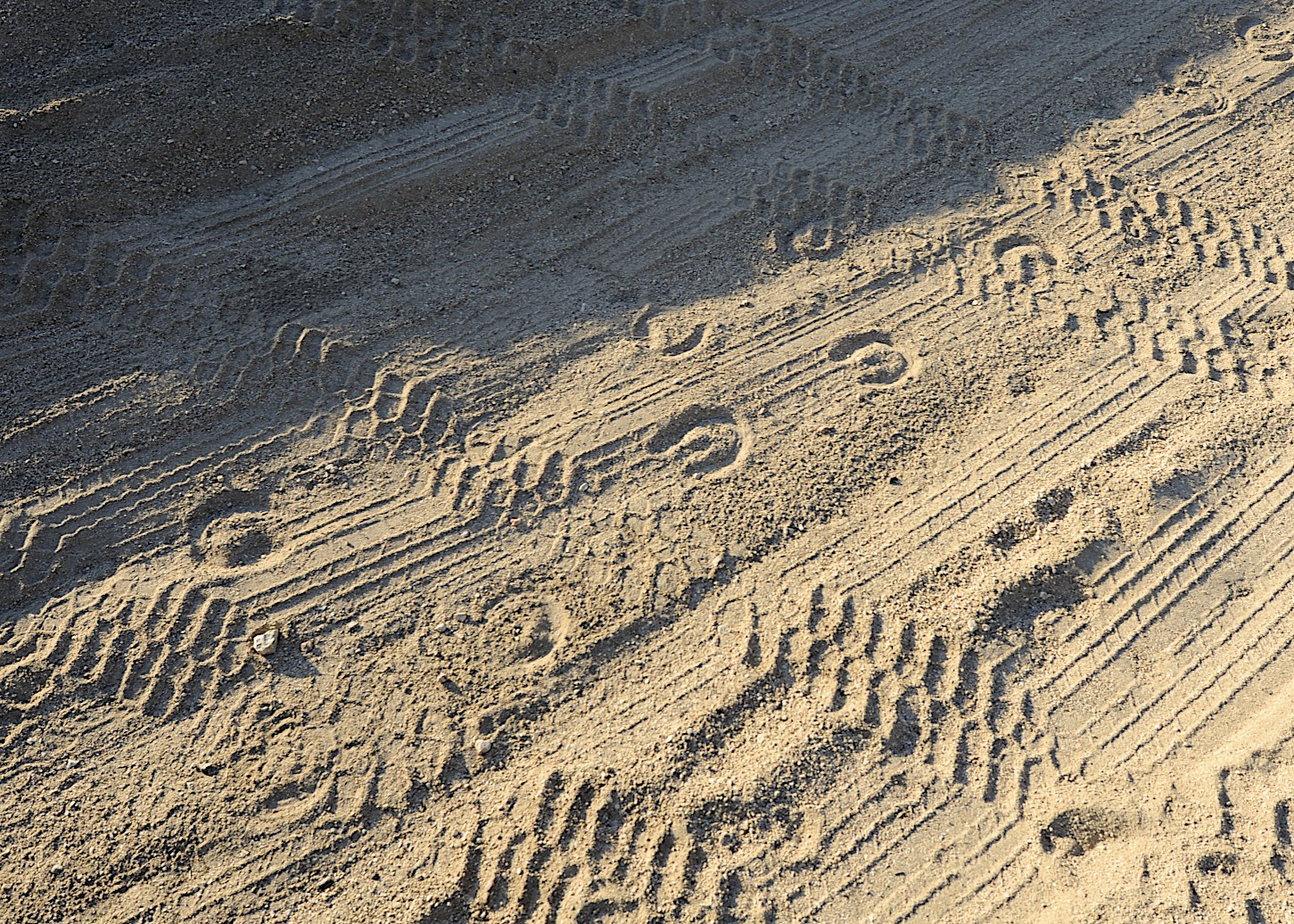
The most obvious place to start is with footprints on the ground. Usually most of us can do basic tracking. Since it has rained in the last week, it was easy to see that there has been a mountain biker passing through recently --- and I would guess a good one by the implied speed that his very direct tracks revealed. Slower you huff and puff, the wobblier it all gets. And he (she?) was able to hold a very lean, efficient course, since the outbound tracks neatly overlaid the inbound ones.
And there were recent motorcycle tracks, a quad, and a light truck. Look at this: horses, too.

Not many coyotes today, though more about them later.
One thing to remember about that attitude of "it's just desert, who cares if somebody dumps trash" (or releases unwanted dogs, or shoots inside city limits) is that if God loves us all equally, so too is all of this land His --- or if not the god of Christianity, then it belongs some Great Spirit or another. We are just his or their stewards. Another thing that ties in with this problem is how degraded this desert has become. This scene would have looked odd to the original Native Americans.

Cheat grass is now the common "yellow" grass of the Antelope Valley, and indeed, most of the American West. Native to Europe and North Africa (same home as the basic city pigeon, by the way), it has displaced the native bunch grasses. A Native American would look out and see Joshua trees and junipers, but the lesser understory, including the kinds of forage that sustained the antelope of the Antelope Valley, all has changed.
(Cheat grass is briefly green of course after a wet winter; it burns easily and so deprives native plants a chance to re-establish themselves --- get get burned out with the yearly fires that now blacken our inter-Valley roadsides and immediate hill lands.)
We all leave tracks, even the ants. They are not native either (experts tell me that to find "pre-White Man" insect regimes, one needs to go out to the Channel Islands), but they often develop similar patterns of land use. Almost always you can find seed hulls and darker debris on the downhill side of ant colonies. Their debris fields look just like the mine tailings one sees spilled downhill from mine shafts around Randsberg or Mojave, just scaled several orders of magnitude smaller.

Harvard biologist E.O. Wilson would say that they live in their own sensory universe, just as we live in ours; they may not have Country Western music, but they have a sense of community that we might envy if we truly could experience it.
Ants change the world, not that we mind much (unless they're in the kitchen, or at AVC, in my office, as they are now). Erosion may be natural but often careless land use accelerates it. I studied this small arroyo, certain that it's bigger than it would be naturally. The juniper roots sticking out and the abandoned rabbit warren shows us that something (fire? removal of brush? changing of drainage patterns?) caused much more unchecked flash-flooding to rip down this sandy wash than used to happen, and as the water came and went, it undercut a big chunk of hillside.

This sand below looks like it's natural but it's been dumped from the back of a truck --- left over from the matrix necessary to mix concrete, or maybe part of a child's backyard playground that never got built. It is recent enough that the cheat grass has not found a way to recolonize the stifling layer that was dumped on top of it. Littlerock and Santa Clarita are the closest quarries for sand in construction, so it's possible this small pile is not far from its pit of origin.

Next on my list was something related to the sand pile but that I think is called washout: the leftover plaster or cement at the end of a project that is hosed out of the hopper and left on bare ground to dry and crumble.

I think that is what we have here, but sometimes when abandoned panels of drywall erode, they begin to crumble back into fractured slabs of plaster, especially once the paper finish weathers off. Pretty darn ugly (and pretty loutish behavior), either way.
Beds and mattresses can last a long time in our arid climate: judging by the coil springs, that's what this first item was once, maybe even as long ago as forty or fifty years ago, and down wind, maybe from this bed but probably from more recent cushions, some synthetic batting had snagged on a Joshua tree.


We've not run cattle in Palmdale since the 1950s, so far as I know. (Maybe into the 60s? I doubt it.) Different rainfall patterns and different and higher levels of ground water allowed the High Desert to have a brief cattle boom, and into the 1930s, range cattle were run on what is now Joshua Tree National Park. Where there are cattle, there are fences, and this barbed wire almost certainly is a long-since forgotten demarcation of where one ranch ended and another started.

Barbed wire can trip unwary hikers and puncture mountain bike tires, but I think for some of us, it's a sign of nostalgia, too --- a symbol of the gunslinger, spurs and cowboys American West. My father, a former ranch hand, used to have a wall display of the different species of barbed wire. It's hard though to romanticize old tires. This one looks recent. Did it demarcate the turn on a course? Was is just left as basic trash? Did somebody's car throw a wheel here? Who knows, but we may have fifty or a hundred years to look at this and figure out the rest of the story.

Holiday weekends can be risky times to be in our local recreation areas, what with forest fires, drunk drivers, loose dogs, and the ubiquitous American firearm. Most local desert patches show signs of shooting and hunting. This pallet is not left over from some now-abandoned onion farm or Rite Aide warehouse, but was the platform for target shooting.


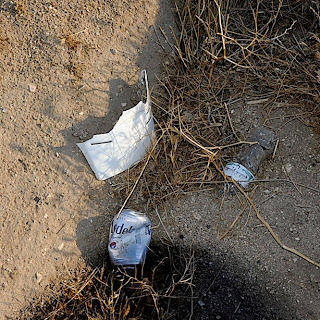
Some of the things under our feet are not just one symbolic emblem of a single moment in time, but reveal a layering of multiple histories. Here in another eroded ditch we have a Modelo beer can implying that the drinker was (possibly) Hispanic, along with a buckshot-riddled target bottle and a stray plastic housing that could have been from a mystery household appliance. (Are the local dump fees really that high, to prevent somebody from taking household trash all the way to the landfill? If you pay your trash bill, you get free vouchers to use the landfill without cost.) Some scorched earth shows there was a small fire here, maybe started by a cigarette but able to burn itself out without spreading. Here's the shot of one of those combination piles.
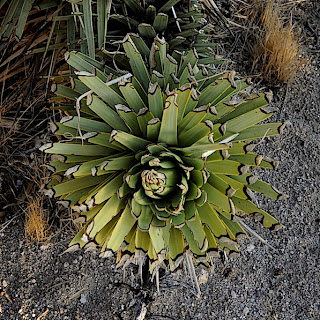
Fire may explain this shot below, a stunted branch on an otherwise healthy Joshua tree. The tips of the lower spikes were all chewed off, except nothing eats Joshua trees any more, and in fact, nothing has for 10,000 years. It clearly looks like fire damage, except nothing else showed any presence of a recent fire. Perhaps this fire was as long ago as ten years back --- the soil has turned over, the cheat grass has flourished, and only the slow-growing Joshua tree bears witness to yet another forgotten brush fire. Is that the story of mankind? We come, we burn, we leave.
Wearing hiking shoes and wool socks I don't have much contact with the ground directly, but Lucy has a great way of telling me when we've come to a damper, better shaded, and more cool stretch of earth --- she sprawls out to rest, pressing her hot belly against the cool sand.
English teacher Santi Tafarella has taken to calling my dog either "Hound" or "Hooper" (or both), for reasons perplexing both to the dog and me. "How's it going, Hooper," he asks, setting down on the sofa. She doesn't mind what he calls her, so long as he tunes into her telepathy, which usually is saying, "Go open the fridge and see if any of those enchiladas from lunch are left over. Create a distraction so people are confused, then bring them to me."

Junipers are a native plant of the West, but related species grow in Europe and Africa. Traditionally, gin is flavored with a type of juniper berry, juniper being a root word for the term "gin" itself. This only works in the Old World; our native variety has no alcoholic properties. Native Americans used shredded juniper bark for wigwams insulation, made cooking utensils out of the aromatic and durable wood, and sometimes collected the berries to grind into a type of cornmeal or protein flour. The berries can be eaten raw (or cooked, stored, and eaten cold as a snack); for me they don't do much, but maybe if I had a few gin and tonics first I might be more open minded.
Here we see all the stages of a Juniper --- the dead wood being from a tree that was alive when condors and grizzly bears filled the Antelope Valley.


Our hills still have abundant coyotes, and in fact I saw one on my residential street at 9 in the morning a few weeks ago. Usually hiking I see their tracks much more often than the critters themselves, or, as here, can see the state of the rabbit population by how many they've caught recently.

Coming across such spoor as this causes my dog to leave her own prodigious efforts as well, side by side, in companionable effort. Later, after dusk, when the coyotes patrol past, should I guess what they will think, checking out Lucy's contribution to the library of the trail? Maybe they will pity her that she lives in such a rabbit-poor back yard, or, on the other hand, maybe they will say, "Man, enchiladas again? We always miss out on the good stuff!"
In writing an email to UC Berkeley's Robert Hass, a MacArthur "genius" grant winner who also has been U.S. Poet Laureate, I thought that before I chastised him too much for getting his palm tree facts confabulated in an essay on art, I should first make sure my own biological literacy was up to speed. So with my dog Lucy showing me where to go, I decided to take a Labor Day morning walk and see what a piece of Palmdale scrubland could tell me about my own neighborhood.
More than I expected, as it turns out.
I've been here before --- some land south of the aqueduct off of Barrel Springs Road --- but noticed more this time now that I had a camera than I normally do, when usually I am just stumbling along and muttering to myself, "Where has that darn dog gotten to?"
Humans leave a lot of evidence, as archaeologists have shown us many times before. What will some future generation make of this?

Construction waste obviously, and some of the green panels turned up elsewhere in the area, apparently having been used as planking in a rut when somebody's truck had gotten struck.
The most obvious place to start is with footprints on the ground. Usually most of us can do basic tracking. Since it has rained in the last week, it was easy to see that there has been a mountain biker passing through recently --- and I would guess a good one by the implied speed that his very direct tracks revealed. Slower you huff and puff, the wobblier it all gets. And he (she?) was able to hold a very lean, efficient course, since the outbound tracks neatly overlaid the inbound ones.
And there were recent motorcycle tracks, a quad, and a light truck. Look at this: horses, too.
Not many coyotes today, though more about them later.
One thing to remember about that attitude of "it's just desert, who cares if somebody dumps trash" (or releases unwanted dogs, or shoots inside city limits) is that if God loves us all equally, so too is all of this land His --- or if not the god of Christianity, then it belongs some Great Spirit or another. We are just his or their stewards. Another thing that ties in with this problem is how degraded this desert has become. This scene would have looked odd to the original Native Americans.

Cheat grass is now the common "yellow" grass of the Antelope Valley, and indeed, most of the American West. Native to Europe and North Africa (same home as the basic city pigeon, by the way), it has displaced the native bunch grasses. A Native American would look out and see Joshua trees and junipers, but the lesser understory, including the kinds of forage that sustained the antelope of the Antelope Valley, all has changed.
(Cheat grass is briefly green of course after a wet winter; it burns easily and so deprives native plants a chance to re-establish themselves --- get get burned out with the yearly fires that now blacken our inter-Valley roadsides and immediate hill lands.)
We all leave tracks, even the ants. They are not native either (experts tell me that to find "pre-White Man" insect regimes, one needs to go out to the Channel Islands), but they often develop similar patterns of land use. Almost always you can find seed hulls and darker debris on the downhill side of ant colonies. Their debris fields look just like the mine tailings one sees spilled downhill from mine shafts around Randsberg or Mojave, just scaled several orders of magnitude smaller.

Harvard biologist E.O. Wilson would say that they live in their own sensory universe, just as we live in ours; they may not have Country Western music, but they have a sense of community that we might envy if we truly could experience it.
Ants change the world, not that we mind much (unless they're in the kitchen, or at AVC, in my office, as they are now). Erosion may be natural but often careless land use accelerates it. I studied this small arroyo, certain that it's bigger than it would be naturally. The juniper roots sticking out and the abandoned rabbit warren shows us that something (fire? removal of brush? changing of drainage patterns?) caused much more unchecked flash-flooding to rip down this sandy wash than used to happen, and as the water came and went, it undercut a big chunk of hillside.

This sand below looks like it's natural but it's been dumped from the back of a truck --- left over from the matrix necessary to mix concrete, or maybe part of a child's backyard playground that never got built. It is recent enough that the cheat grass has not found a way to recolonize the stifling layer that was dumped on top of it. Littlerock and Santa Clarita are the closest quarries for sand in construction, so it's possible this small pile is not far from its pit of origin.

Next on my list was something related to the sand pile but that I think is called washout: the leftover plaster or cement at the end of a project that is hosed out of the hopper and left on bare ground to dry and crumble.

I think that is what we have here, but sometimes when abandoned panels of drywall erode, they begin to crumble back into fractured slabs of plaster, especially once the paper finish weathers off. Pretty darn ugly (and pretty loutish behavior), either way.
Beds and mattresses can last a long time in our arid climate: judging by the coil springs, that's what this first item was once, maybe even as long ago as forty or fifty years ago, and down wind, maybe from this bed but probably from more recent cushions, some synthetic batting had snagged on a Joshua tree.


We've not run cattle in Palmdale since the 1950s, so far as I know. (Maybe into the 60s? I doubt it.) Different rainfall patterns and different and higher levels of ground water allowed the High Desert to have a brief cattle boom, and into the 1930s, range cattle were run on what is now Joshua Tree National Park. Where there are cattle, there are fences, and this barbed wire almost certainly is a long-since forgotten demarcation of where one ranch ended and another started.

Barbed wire can trip unwary hikers and puncture mountain bike tires, but I think for some of us, it's a sign of nostalgia, too --- a symbol of the gunslinger, spurs and cowboys American West. My father, a former ranch hand, used to have a wall display of the different species of barbed wire. It's hard though to romanticize old tires. This one looks recent. Did it demarcate the turn on a course? Was is just left as basic trash? Did somebody's car throw a wheel here? Who knows, but we may have fifty or a hundred years to look at this and figure out the rest of the story.

Holiday weekends can be risky times to be in our local recreation areas, what with forest fires, drunk drivers, loose dogs, and the ubiquitous American firearm. Most local desert patches show signs of shooting and hunting. This pallet is not left over from some now-abandoned onion farm or Rite Aide warehouse, but was the platform for target shooting.


Some of the things under our feet are not just one symbolic emblem of a single moment in time, but reveal a layering of multiple histories. Here in another eroded ditch we have a Modelo beer can implying that the drinker was (possibly) Hispanic, along with a buckshot-riddled target bottle and a stray plastic housing that could have been from a mystery household appliance. (Are the local dump fees really that high, to prevent somebody from taking household trash all the way to the landfill? If you pay your trash bill, you get free vouchers to use the landfill without cost.) Some scorched earth shows there was a small fire here, maybe started by a cigarette but able to burn itself out without spreading. Here's the shot of one of those combination piles.

Fire may explain this shot below, a stunted branch on an otherwise healthy Joshua tree. The tips of the lower spikes were all chewed off, except nothing eats Joshua trees any more, and in fact, nothing has for 10,000 years. It clearly looks like fire damage, except nothing else showed any presence of a recent fire. Perhaps this fire was as long ago as ten years back --- the soil has turned over, the cheat grass has flourished, and only the slow-growing Joshua tree bears witness to yet another forgotten brush fire. Is that the story of mankind? We come, we burn, we leave.

Wearing hiking shoes and wool socks I don't have much contact with the ground directly, but Lucy has a great way of telling me when we've come to a damper, better shaded, and more cool stretch of earth --- she sprawls out to rest, pressing her hot belly against the cool sand.
English teacher Santi Tafarella has taken to calling my dog either "Hound" or "Hooper" (or both), for reasons perplexing both to the dog and me. "How's it going, Hooper," he asks, setting down on the sofa. She doesn't mind what he calls her, so long as he tunes into her telepathy, which usually is saying, "Go open the fridge and see if any of those enchiladas from lunch are left over. Create a distraction so people are confused, then bring them to me."

Junipers are a native plant of the West, but related species grow in Europe and Africa. Traditionally, gin is flavored with a type of juniper berry, juniper being a root word for the term "gin" itself. This only works in the Old World; our native variety has no alcoholic properties. Native Americans used shredded juniper bark for wigwams insulation, made cooking utensils out of the aromatic and durable wood, and sometimes collected the berries to grind into a type of cornmeal or protein flour. The berries can be eaten raw (or cooked, stored, and eaten cold as a snack); for me they don't do much, but maybe if I had a few gin and tonics first I might be more open minded.
Here we see all the stages of a Juniper --- the dead wood being from a tree that was alive when condors and grizzly bears filled the Antelope Valley.


Our hills still have abundant coyotes, and in fact I saw one on my residential street at 9 in the morning a few weeks ago. Usually hiking I see their tracks much more often than the critters themselves, or, as here, can see the state of the rabbit population by how many they've caught recently.

Coming across such spoor as this causes my dog to leave her own prodigious efforts as well, side by side, in companionable effort. Later, after dusk, when the coyotes patrol past, should I guess what they will think, checking out Lucy's contribution to the library of the trail? Maybe they will pity her that she lives in such a rabbit-poor back yard, or, on the other hand, maybe they will say, "Man, enchiladas again? We always miss out on the good stuff!"


