Sunday, April 17, 2011

In Praise of Veterans

It’s Not Memorial Day (but Thank You anyway)

It is nearly the anniversary of a small but important date in World War II, and that prompts me to stop and honor the US military personnel, past and present, who share my classrooms with me.

Because I teach online classes, some of my students are physically far from campus—sometimes really far. As in, serving overseas and yet still trying to stay up on their studies. God bless all of you. You give me hope and determination. Perhaps some of these folks are the people Paul Simon had in mind when he wrote his newest album, So Beautiful or So What.


This is a very spiritual album, filled with grace and redemption, and a meditative one too, as he thinks about the simple beauty of our lives, our planet. In the song “Getting Ready for Christmas Day,” the narrator says “I got a nephew in Iraq / It’s his third time back / But it’s ending up the way it began / . . . he’ll [ end up ] eating his Thanksgiving dinner / on some mountain top in Pakistan.”

Is it “good” English if somebody says, “I was due to rotate home but I got stop-lossed, so am still stuck here, all effed up”? Good English maybe yet sad reality. (There is a tradition for using the language of military slang in literature. T.S. Eliot in his landmark 1922 poem “The Wasteland” speaks of Londoners who were being de-mobbed, that is, being de-mobilized after World War I.)

Paul Simon’s song has layered into it a “call and response” African-American sermon from 1941, the year that World War Two started. My father served in this war, from the first day to the last, and yesterday in an old journal I found a note in my late father’s handwriting. Here it is:


My dad served in the Navy, and among his duties was to stand watch at night on an anti-aircraft battery. In the note he is remembering the time while on nighttime watch he saw the glowing sparks of the engines, as General Doolittle revved up his bombers on an adjacent aircraft carrier. This became known as the famous “Raid on Tokyo.” Some of the younger students may not recognize his name, though he is commemorated on Lancaster Blvd.

Discouraged by our losses at Pearl Harbor and the immediate months afterwards, the American people wanted some indication that we could win this war. Jimmy Doolittle provided it. In an audacious (almost suicidally brave) raid, he launched a flight of B-25 bombers from an aircraft carrier on a one-way flight to the Japanese main island of Honshu.

They took off from the U.S.S. Hornet, as my dad’s note recalls. You could—barely—get these medium bombers to take off from an aircraft carrier, but you could never land these planes back on any U.S. ship, so these were missions that would cross the Pacific, bomb Tokyo, and then try to reach friendly territory in Russia or China before running out of gas. Some crews made it, some died en route, and some were captured and executed. The mission’s success was not measured in bomb damage, but in morale: the raid electrified the American people. To his dying day, my father remembered hearing the engines start in the dark, and then watching the red glow of the engines as they revved up prior to full-throttle takeoff.

He served in both the Atlantic and the Pacific, and over the years, as chance allows, I have tried to visit some of the places he served. This picture below looks like a simple slice of paradise but instead marks another important piece of American history.


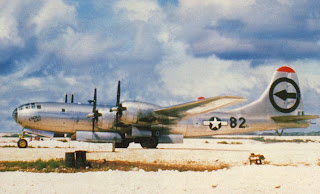
True, the water here is spa-tub warm, and the nearby coral reef swarms with beautiful fish. This is the island of Tinian. On this beach—the exact spot where this picture was taken— the U.S. Marines came ashore to capture this island from the Japanese. Out of sight to my right are the rusting remains of U.S. tanks, and behind me as this picture was taken are the concrete shells of Japanese bunkers. Later this island became an important airbase, and it was from this island that the Enola Gay took off in August, 1945, carrying the atom bomb destined for Hiroshima.


Tinian today, as the beach picture reveals, has been by-passed by development. There are some small and overgrown markers memorializing the war, and from the air, coming in by propeller plane, one can see the stripes of lighter jungle cut into the darker bits, marking where the old airfields have filled in.

It is easy to forget the sacrifices of the people who helped make us who we are, and as the anniversary of the Doolittle Raid approaches, I just wanted to take a moment to say thanks Dad, thanks veterans, thank you to all who believed enough to make the world a better place. Musician Elvis Costello says that Paul Simon’s new album “rejects the allure of fashionable darkness and the hypnosis of ignorance.” The music (Costello says) celebrates “the endurance of spirit and the persistence of love.”

On the anniversary of the raid I will put a flag out in front of my house and driving to or from the college, to or from Trader Joe’s, to or from picking up my kids, I will play the new CD, paying particular attention when a closing song says “something called me / from my sleep / [ it was ] love and blessings / simple kindness / ours to hold / but not to keep.”

Sunday, April 10, 2011

Solidarity

The Budget in April (notes from the cemetery)

As spring break week winds down, it is such a warm and perfect Sunday that instead of going to church, I went on my bike to the church of the grass, the church of the sky.

There is much to think about: I have friends abroad and here, administrators and teachers, who are losing their jobs, and meanwhile, at AVC, we will have what I assume will be a contentious Board meeting on Monday, followed by what could be an equally-contentious all-campus staff meeting on Tuesday. We face class cuts, layoffs, salary reductions, and partial closures. Things will change, and most of it not for the better.

Yet in Yosemite (where I was earlier this week), the Western Redbud is in bloom.


Waterfalls flow in gushing white profusion and the same Steller’s Jays as always beg for crumbs outside of the Lodge cafeteria.

It made me think of a story I heard when I was in Poland this fast autumn. I met with somebody who had risked Siberian exile to defy the Communists, and for whom “solidarity” means not just a labor party or the fall of the Berlin Wall, but the very essence of humanity itself. He talked about the secret police, and his friends who disappeared, and he quoted a Polish poet, Wislawa Szymborska. She once said, “we are—each of us—the miracle of an alder tree. Many miracles in one, in fact: the miracle that the tree is reflected in the water, that the tree is backwards left to right, and the miracle that it grows there, year after year, crown down, and yet it never reaches bottom. The miracle of where the water comes from, where it goes, and the miracle of how vividly and permanently we can see it, even when we are far away.”

He said that for him, it was not the miracle that the Communists left (sooner or later, he said, even if it took hundreds of years, he knew they would), but that he and the people left behind had managed to make a new society so easily. Do they know who had collaborated, who had resisted? Of course. (He could also give me the full names of everybody in his family who disappeared in World War Two.) The important thing is that those who survived then turned and imagined what they wanted the new world to look like, and turned right around and began to build it.


True, AVC faces its worst budget reduction ever. What the next weeks will bring I am not sure anybody can predict.

Yet even so, I will stand with my students and friends, colleagues and deans, as we remind ourselves that the greatest thing we can do is to be sure the college remains open and that we teach well and truly as many students as we can fit into the rooms, the halls, the deep and sometimes wounded places in our hearts.

The only defeat will be to give up and fail to adapt. Indeed, under the most dire of the predictions, I have heard it asked, can the community colleges even survive at all?

The answer is yes. Yes we can survive.

Yes we will survive.

And, yes, in solidarity and hope, we must survive. The future generations of California expect and deserve nothing less.

Saturday, April 2, 2011

A Cage for Dinosaurs

Meditations on Construction and Change at AVC

In search of good news and a quiet place to walk, on a recent Saturday I spent some time enjoying the progress our bond-funded construction is making on main campus, and was thinking too about the possibilities for our Palmdale site.

Things are changing fast on campus, and it’s not all just pay cuts and cancelled classes. It seems like only yesterday when I took AVC journalism students on a “how to shoot” tour of the new Theatre Arts complex. At that time, the site was mostly scraped up dirt, bundled piles of rebar, and abundant hope.


Time passes—welders weld, bolters bolt, and the magic happens. Now, finally, as anybody driving west along Ave. K will have noticed, we are close to thinking about the grand opening.


I can’t wait to go to the first performances. As fond as I am of hearing the LA Phil inside the Disney Concert Hall or going to plays done by Glendale’s (soon to be Pasadena’s) Noise Within, the fact is, AVC’s Visual and Performing Arts faculty and students provide world-class performances, often for less than the price of two fancy coffees at Starbucks.Here is a shot of Test Flight (our student rock band) as well as the Antelope Valley Symphony as conducted by Dr. David Newby, with background images provided by JPL. We will learn more about the symphony in another post, as we think about the great American poet, Walt Whitman. Here are the arts in action:


On another side of campus, a new science complex rises from the dirt. Here is a “then” shot (wasn’t this just a year ago?), versus a few “now” shots, from today.


Of course, some projects now have reached the “ready to move in” phase. Have a look around the tech ed and greenhouse areas on the north side of campus next time you have a moment to spare. There is even an allusion to a scene from Jurassic Park.


One bit of construction that has already come and gone was carried out (without permit or permission!) by our resident owls, who successfully nested and raised young again this year. Their nest is no longer required: Junior is already so large he is out of the nest (or it could be a she; at this age, there is no way to tell them apart visually), and now has almost fully fledged.

He (or she) waits to start hunting actively, and for now, sleeps near the library during the day, a parent usually protectively roosting nearby. Here is the juvenile.


It is easy to find our owls during the daytime. Just look for their cast-up pellets. These are small, cylindrical wads of fur and bone that the owls cough up because they cannot pass some material through their digestive systems. Look around the grass under the big pine trees for a scattering of owl pellets, then, when you find some, look up. One or two owls are probably right over your head, looking back down at you.


The pellets themselves reveal what the owls have been having for dinner. It is okay to touch these, and to let kids touch them too. You can just pull them apart with your fingers and see what the bones have to tell us. Great Horned Owls eat rats, mice, rabbits, domestic cats, skunks, and even scorpions. In their detritus you can find tiny mice teeth or itty bitty vertebrae. If you come across some of the pellets under one of the campus trees, it is okay to pull them apart to see what drama has been going on during the swing shift. (Just be sure to wash your hands afterward, and don’t lick your fingers until you’ve cleaned up.)

If you want to play CSI, that’s fun too: just bag and tag, then do a home dissection with tweezers and rubber gloves. It is more fun than watching tv (as most things in nature are).


These nests and buildings so far all have been from the main Lancaster Campus, but what is happening in Palmdale? The District still owns a lovely piece of vacant property near Pearblossom Highway and 25th East.


Times are hard. We all know this: the State may not be bankrupt, but it’s no longer in the “building colleges” business. Our current bond money—generously supplied by District voters—cannot be diverted to Palmdale, even if we wanted to. (And we have to finish the current projects first, anyway.) A new, stand-alone Palmdale campus won’t be breaking ground any time soon. But that is not to say it will not come. When the main campus was started at its present site of 30th and K in Lancaster, prevailing comments (I am told) went along the lines of, “whad’a building it out there fer?” It seemed utter folly. Roads were not even paved this far away from town. The west side wasn’t a side, it was just jackrabbits and dust devils.


But times change—buildings are planned and built; trees grow tall and owls make homes in them. There will be a Palmdale campus. Maybe not this year or even the one after next, but it will come. (And to be accurate: we do have a Palmdale campus; we just do not have a Palmdale separate dedicated site for the Center that now exists.) Funding will be an issue, but then it always is (and always has been). Maybe R. Rex Parris will donate the money, if we promise to name it after him.

One issue for people to dream about is, when it comes, what do we want our next college campus to look like? At times I am deeply fond of the Lancaster campus, with its stamped sheet metal sun-shades (what were they thinking?) and its trees leaning 45 degrees off axis. But when we think ahead to the next incarnation of AVC, what should it be?

While I am sure the Office of the State Architect will have various requirements for us, and while we will want to include restrooms and parking lots and soccer fields and maybe even a drive-thru bank, speaking just for myself, I already know what the next installment of AVC should look like.

Ladies and gentlemen of the Antelope Valley constituencies, may I present to you the new and improved AVC, the Palmdale Campus during its grand opening, 2021:


Instead of being a dirt lot off of 25th East, the Palmdale campus will be the hip place to see and be seen. All of the up and coming local bands will want to jam at the opening, and the mayors of Palmdale and Lancaster will give three speeches each. Rich Sim will still be the most senior faculty member still serving, and the art buildings (the ones we don’t name after Rex Parris) will be named for him.

See you there! (Just don’t forget to put a parking sticker on your space ship on your way to class....)

Thursday, March 24, 2011

Blind Artists (a brief postscript)

Follow Up to Other Posts

Thank you to those of you who told me about using the video link in class, as the story of the blind photographer and the New Orleans band and all of that is very touching to me.

I am in Chicago, doing work for a journalism lesson, and have been trying to let that sensibility inform my own visual notes. Listening to a mix of rain and snow and hail play against the glass of my hotel window, I tried to capture that dislocated sense of mixed up weather by shooting through the thinnest part of the curtains. It is not great, but I am glad to be trying to listen to the world differently.


And inside the Art Institute of Chicago, they have a gallery for sight impaired visitors, where the "wall text" is in Braille and one can freely touch the art. How wonderful!


Several people may have responses about our notes on Kindle versus books: the iPad side of the block is ready to enlarge the dialogue. Something about that may come shortly. Last, at the same museum, their entrance steps have this text-based artwork installed into them, and I am not sure what it means, but I sure do want one for the stairs inside my house!

Sunday, March 20, 2011

Is Kindle an Agent of the Devil?

Thoughts on e-Readers and the Decline of the Book

Although I own more books than just about anybody I know and although the tactile pleasure of a well-printed, well-designed book still thrills me, I also am an advocate for Kindles and other e-book devices. Is this wrong? Am I agreeing to set fire to very church that I want to worship in?

My reactions are complicated by the fact that textbooks soon will be predominantly online (or will they? see below) and in using a e-book, one gives up a lot, including just the pleasure of the paper pages and the ease of making notes and sharing xeroxes of favorite passages.

Former AVC Writing Tutor Abbey Fitting was considering buying an e-reader as the platform for all of her required textbooks next term at CSU Bakersfield. As a lit major, many of her assigned books are available as e-book downloads. She wondered, should she make the switch? After all, the very prestigious WW Norton company has just released their latest writers’ handbook in a mobile phone edition, and supposedly Kindle versions of books now outsell regular editions.

Did she want to spend the money and switch over? The rest of this blog is guest written by Abbey Fitting, as she shares her reasons for the decision she made.


To Kindle or Not (by Abbey Fitting)


For the book lover there is nothing more pure, more essential to life, than a good book. That arrangement of language, whether in poetry or novel or essay form, moves us to tears and to laughter. At times it can frustrate us with complexity while at other times it soothes our hot and angry souls. For some of us it is an escape into another place; for others an inspiration to be more than we are.

Books are a source both of love and of constant anxiety. I always fear that I will end up somewhere without something to read. I am never far from a book and I have them even in my car (just in case, you know). I pack obscene amounts of them on airplanes for fear I’ll finish one or more before we land.

On a recent cross-country road trip I practically installed an entire bookshelf in the back seat, clearly worried that I’d end up in some mysterious part of the country where they didn’t have books and I would finish mine and be left empty-handed.

If were to say to another book lover, “Here, I’ve found a way that you can take your entire library with you, always and forever, it’ll never be more than a few inches out of your reach,” I might have expected them to hug me and award me the bookish version of the Medal of Honor. Yet if I say the above and then hand them an e-reader (a Kindle or Nook or iPad), they will probably cast it to the ground and shun me from the clan of readers. Heretic, they will say. Apostate. Be gone!

But WHY? I imagine myself shouting to them. It’s all there! After all, for books, it seems that if everything I have listed above still exists if it is translated into a digital format. The power of the story to sweep us away, the joy of an excellently written poem—it’s all STILL THERE. And consider the possibilities! No more traveling with just five or six paperback books, you could instead travel with one slim Kindle and have inside, magically, 10,000 paperback books! And (almost) anywhere in the world you could order a new book in your native language.

Never. Ever. Be without something good to read ever again.

It sounds like a small version of paradise. Why shouldn’t we embrace the digital book as our savior?

The answer, of course, is not simple. But I think I’ve got it figured out.

It is because our books, or I should say, the printed artifact that we call a book, are so much more than the words they contain. If mothers save clippings of their children’s hair at certain ages, and some sailors collect vials of sand from the beaches they’ve visited, then most serious readers collect books. Our books are artifacts of our lives. They are souvenirs of our changing personalities and tastes. From the copy of Harry Potter that you bought hot-off-the-presses in 1997 to your copy of Shakespeare: the Invention of the Human that you bought in 2007 for a class, these books are the history of ourselves. And not just a visible, tangible way to see the person-you-were vs. the-person-you-are, but also of the places—the physical geography—where you experienced those books.

In December of last term I spent a few weeks in Botswana doing the safari thing with my husband and a pair of friends. For that trip I took with me Neil Gaiman’s American Gods. I’d read it before, but since I’m starting a writing project centered at a place featured briefly (though prominently) in the novel, I was re-reading it for the sake of research and, also, because I just liked the story. Into the daypack it went.

What does the book look like now, after that? Between four twelve-hour flights from here to London to South Africa and back, in between six bush plane flights and five field camps, it took on quite the patina. A thick section of pages came loose after a thunderstorm made the air so humid you could have gone swimming in it. The cover has been bent in a number of places, the spine is so broken at this point that it can lay flat (not easy on a paperback this size), there’s a shoe-print on one of the pages, there’s a dead ant embedded in another, and a number of dead are gnats preserved too. It has a faintly mildewy scent about it (though by now, three months back in the arid desert climate, it is definitely dried out, creating that wavy, pleated look).

In some ways this beat-up novel has taken on a different story, one not written by the author but written by me: Abbey’s travels in Africa. I read this book and heard hippos fighting over territories. I read this book waiting for a bush plane to come pick me up. I read this book and looked up to discover a group of giraffes (young included) moving into the camp, browsing the leaves high over my head. I read this book and looked up to discover a group of vervet monkeys were sneaking closer to attempt to steal my snack. It can do this because it is just one book. This is the book that I chose to take with me; this is the book I read while traveling in Africa.

This is what an e-reader will never be to us. This is what we mourn when we give in and buy one; this is what we shun when we hold fast against the pressure to do so. A Kindle holds 10,000 books, it’s true. It could, potentially, hold all the books currently stacked around my office. But because of that, it will never take on the patina of being “The book I read when….”

It will get scratches, it’s true, but you won’t remember the how or why or where, because it will go so many mundane places with you. And when it breaks, you won’t fight with yourself about replacing the way I do when I consider buying a new copy of a book that I’ve just worn the spine out on completely, because it’s like buying a new cell phone or a laptop: You expect to need to replace it. You expect the battery to wear out. You expect technology to leap ahead and leave it behind.

This doesn’t happen with our physical books. We buy new books, sure, but we love them or we pass them on. We don’t consider our books outdated; we don’t need to upgrade them. If anything, we love them more as they get older. We love how the ideas that had been so commonplace suddenly become stranger and stranger. We love that odd smell they take on, or that weird yellow color.

I suppose ultimately what I’m trying to explain is not why you should avoid an e-reader— please, buy one. I wish Amazon no ill will, and I have spent many days at Barnes & Noble, looking at a Nook. But rather, what I am trying to explain is why it is so hard for us to give up our real books. Why we fight so hard to keep them, and why, in our hearts, no matter how good the story is on the e-reader, we will always know that it is not really a book.

The book is dead. Long live the book.


Monday, March 14, 2011

From Littlerock to Paradise in 20 Frames

What Blind Photographers Can Teach All of Us
 
As singer Leonard Cohen says (and poets like to repeat), everything has cracks—that’s what lets the light in.

We think of our world as flooded with light, and, in the Antelope Valley, there’s often so much sunlight that to hide from it we need sunglasses tinted as dark as welding goggles and deeply-canted parking awnings.

If some of us have too much light, what about our friends and neighbors whose eyesight is, in the literal sense, absent or deeply impaired?

I have been thinking about blind photographers lately, and that has made me reassess what it means to be an artist, what kinds of pity I too-quickly put onto people, and what assumptions I have been making about creativity. An passage adapted from the Bible reminds us that there are none so blind as those who will not see, and conversely, the true artist is she or he who sees more deeply, more wisely than any of the rest of us. Great art opens our eyes in many ways.

A video link proves this well, as it introduces us to the world of Peter Eckert, a blind photographer who does amazing work, and reveals the difference between sight and insight, between hope and despair. This blog will not usually embed many video clips or external links, but this is truly something beyond average that I think you will be glad to have seen. This four-minute video should help all of us think about labels, ability, and vision. It really is inspiring.

http://vimeo.com/14179548

I had been aware of his work before, but had not paid attention to it closely enough. This is not to my credit—we should never be so busy or so prejudiced we can’t make a space in our hearts for the best that the world has to offer.

In case the video link didn’t work for you, here is a copy of something of his from a book called Sight Unseen: International Photography by Blind Artists.


This book documents a show that was hosted by UC Riverside’s California Center for Photography.

One of the artists profiled in the show (which is available for review online, as is the exhibit catalogue) uses braille typography to overprint his photographs: completely unsighted visitors may run their hands across the print and read it that way. Here is a photo from the book, of an image by Gerardo Nigenda, an artist from Oaxaca.


(Sorry about the distortion on this one: future blogs will be using a scanner not a camera to make reproductions and will have better quality images!)

The exhibit’s curator suggests that photography by sight-disabled artists often falls into three groupings. One group of these artists "constructs, maintains, and curates private, internal galleries of images. Then they use cameras to bring their inner visions into the world of the sighted. 'I photograph what I imagine,' writes Evgen Bavcar. ‘You could say I'm a bit like Don Quixote. The originals are inside my head.'"

This from an essay titled “Shooting Blind.” Douglas McCulloh goes on to say that a “second group deploys cameras to capture the outside world, but, being blind, operate free of sight-driven selection and self-censorship. Marcel Duchamp wrote of ‘non-retinal art,’ an art of the mind, of concept, of chance. These artists are engaged in non-retinal photography. The results are pure, unfiltered, and inherently conceptual. They operate beyond the logic of composition or the tyranny of the decisive moment.”

Last, McCulloh explains, “The third and smallest group is legally blind, but retain very limited, highly attenuated sight. Most photographers see to photograph. These artists photograph to see.” An example is Bruce Hall, from Irvine, California. Here is a portrait he has made of his autistic son enjoying the tactile pleasures of the bath. I don’t know about you, but I can’t match this with pictures of my own kids. The purity and innocence of the moment are perfectly served by the artistry of the print.


All of this inspired me to go out this morning and tree to see what it is I overlook daily. Yesterday I had come back from a wedding in San Diego in a great hurry, and while I didn’t get a speeding ticket, I blew through the towns along the 138 as if they were impediments or nuisances, not communities where people live, work, pray, or support my wage packet by attending AVC English classes. I went back this morning to see what things I had been missing. Quite a lot, apparently!

Here are a few things from today’s exploration of Littlerock.

Thank you to these other artists for making me confront my own blindnesses.

Son of Blog

Regular Feature Returns

Sorry for the delay: after Antarctica, AVC’s blog options began to divide and braid like glacial streams. Santi Tafarella will be helping with an accreditation blog and a pedagogy blog for the Basic Skills program, both of which will be available only to faculty, and Charles Hood (self portrait below: I am the tall shadow, not the fat dinosaur, though some would argue the reverse) will be doing the community blog, which is the one you are reading now.

Santi’s updates depend on program review schedules and faculty input, but this blog will change about once a week on average. Initial features in the next month will talk about blind photography, the amazing renaissance in children’s picture books, the aesthetics of sports, whether or not Kindle is an agent of the devil, and the relationship between the poet Walt Whitman and the AV Symphony. On average we won’t cover politics, offensive content, or immediate news items; other venues exist for those. We will though have guest bloggers and a variety of opinions. The first of the new, post-Antarctica posts will be up shortly.